
Identifying features
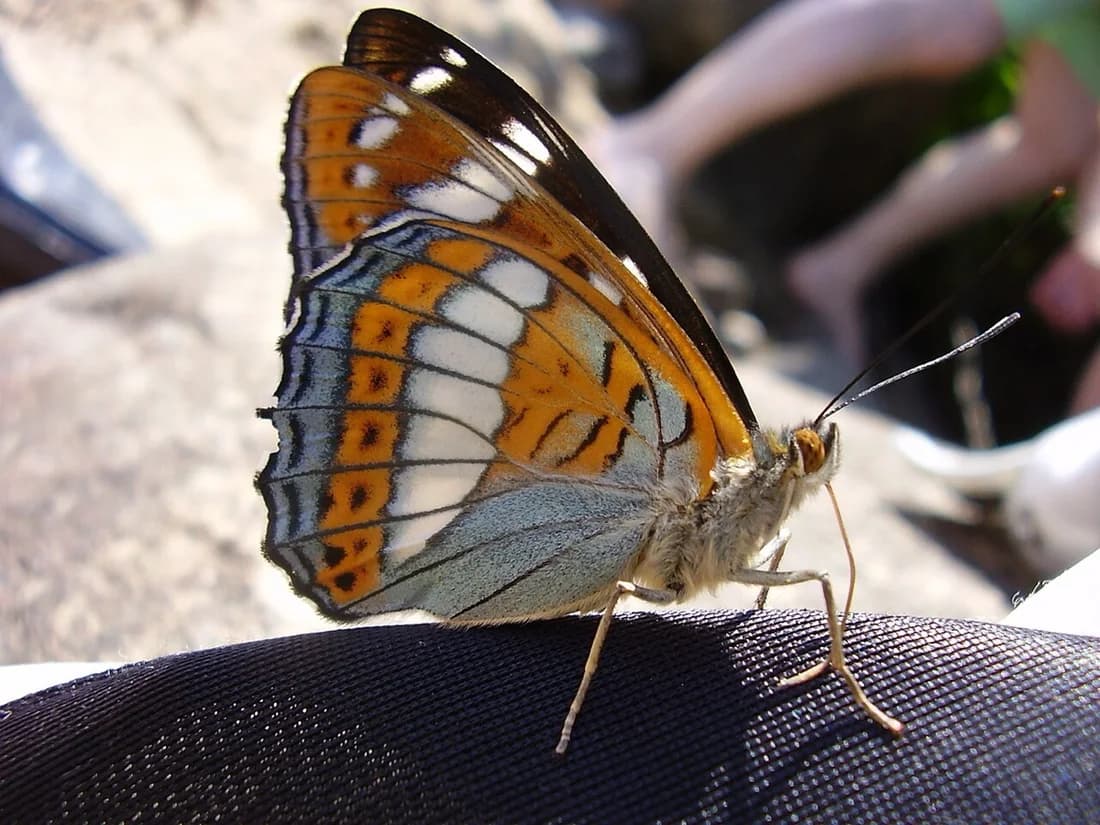
A very large, beautiful, and distinctive butterfly with a wingspan of 69–90 mm. The upper sides of the wings are black/dark with wide white areas, bands, and spots, but there is also a hint of dusky blue and rust-red/orange crescents. The males typically have wider white bands than the females. The underside of the wings is orange with white and black, as well as a darker bluish-grey and sometimes a slight greenish hue – a complex and varied pattern.
Similar species
For a long time, it was impossible to confuse this spectacular species in Norway, but now purple emperor (Apatura iris) is well established in the southeast of Eastern Norway and is still expanding, and this species is somewhat similar to a small example of Poplar Admiral.
Distribution
Widespread and occasionally quite numerous in lowland areas, particularly in moister forests with aspen, from the east in Agder to the municipalities of Åmot and Trysil in Hedmark (Innlandet county). Only one older record exists in Rogaland, which would represent the westernmost location. Population size may vary significantly from year to year. Approximately 1,160 records. The species is believed to be climate-sensitive and has, in recent years, expanded somewhat northward, and apparently also westward.
Biology
The larvae feed on leaves of young aspen. It overwinters as a small larva. It does not seek out flowers; instead, it obtains nourishment from sources such as carrion, excrement, and urine. It is often found on gravel roads (particularly the males), mostly in the morning – where it may absorb moisture, salts, and minerals. It can be attracted with old cheese. Newly emerged individuals are surprisingly unafraid and may even settle on sweaty people.