
Identifying features
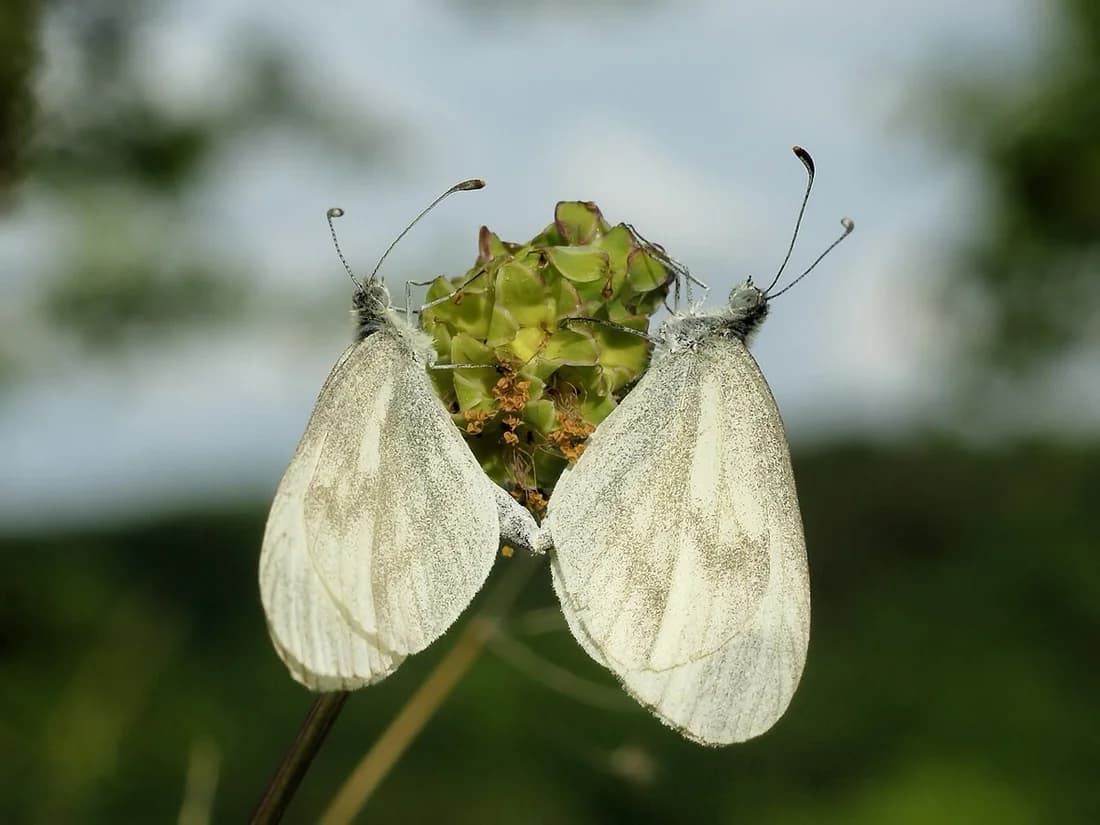
Wingspan 36–44 mm. The wings are white and teardrop-shaped; the body is slender and relatively long. The male has a grey apical spot on the apex of the forewing; in the female, this is reduced to grey dusting along the veins. In the late-summer generation, the male’s apical spot is more black-dusted.
Similar species
Very similar to Cryptic wood white, and the two species can usually not be distinguished reliably from their wing patterns alone. In Wood White, the male’s apical spots are somewhat less clearly defined and relatively round, and in our generation, it is largely a uniformly grey colour; the female has dark dusting along the veins. For a reliable species determination, one should examine the genitalia.
Distribution
Quite common in the southern part of Nordland. Also, an isolated occurrence in Alta in Finnmark. It appears that Wood White has become less common in recent years.
Biology
The larvae live on pea plants and are indicated from vetch (Vicia), pea tendrils (Lathyrus), bird's-foot trefoil, and clover (Medicago); some of the indications in the literature may in fact refer to Cryptic wood white. The larva is green with a yellow lateral line and cannot be distinguished from the larva of Cryptic wood white. The pupa overwinters regularly.