
Identifying features
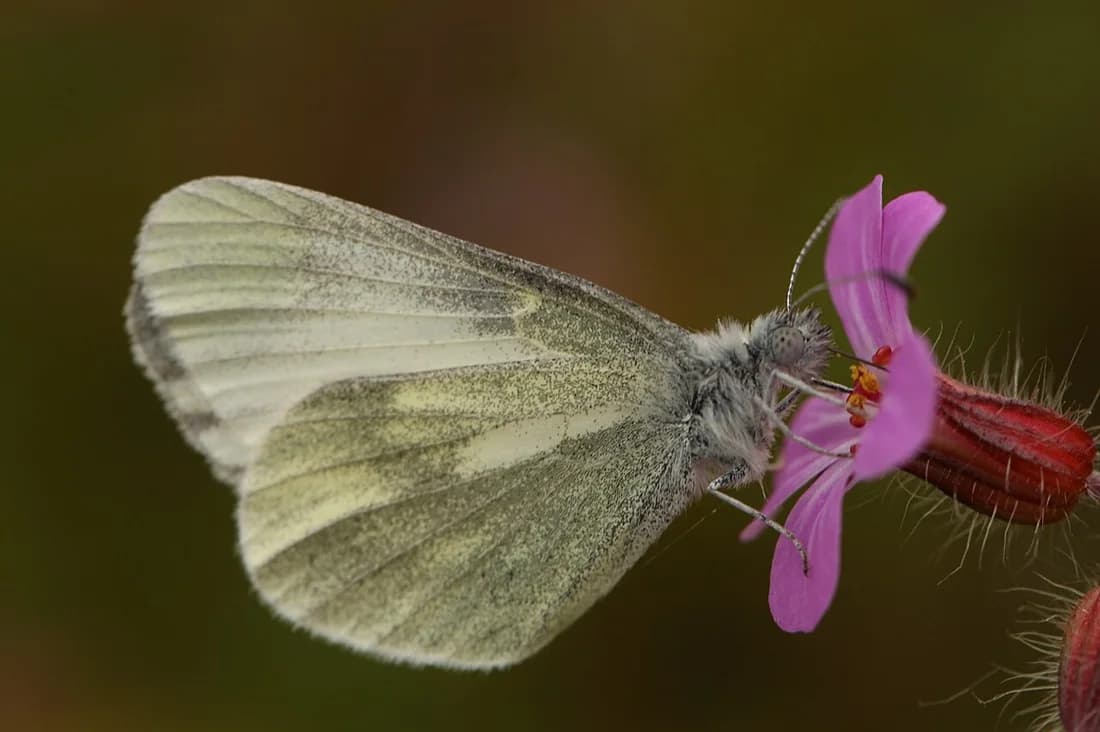
Wingspan 36–44 mm. The wings are white and drop-shaped; the body is slender and relatively long. The tip of the forewing has a dark apical spot, which is most prominent in the male; in males of this generation, the apical spot is also accompanied by black dusting.
Similar species
Very similar to Wood White, and the two species can usually not be distinguished reliably from their wing patterns alone. In Cryptic wood white, the male’s apical spot is clearly marked and extends towards the wing base on the front; the female usually has a clear apical spot. For a reliable species determination, one should examine the genitalia.
Distribution
Locally occurring on the eastern portion of Eastern Norway, Østfold, Akershus, the southern area of Hedmark, the Mjøsa region, and Gudbrandsdalen. Also, a few records from Sogn og Fjordane and Møre og Romsdal. Much rarer than the closely related Wood White; in some locations, the two species may be observed flying together.
Biology
The larva’s main host plant is probably meadow vetchling. It is green with a yellow lateral line and cannot be distinguished from the larva of wood white. The pupa usually overwinters and emerges the next spring, but can occasionally emerge after a short time, producing a small second generation in July–August.