
Identifying features
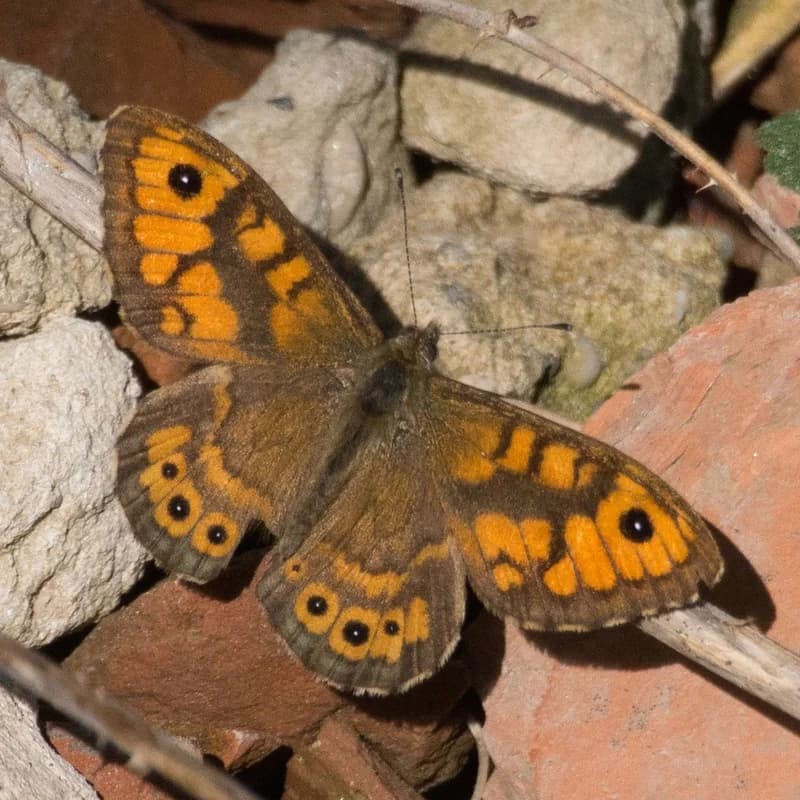
Medium-sized brown butterfly. The upper side of the wing is brown, with large, ochre-yellow, square spots covering most of the wing surface, such that this colour dominates. The large eye spot at the tip of the forewing is slightly smaller than in large wall brown. Males and females have slightly different appearances. At the outer edge of the hindwing, there are 3–5 small eye spots.
Similar species
Resembles large wall brown (Lasiommata maera), but the large eye spot at the tip of the forewing is somewhat smaller. It cannot be confused with any other butterfly in Northern Europe.
Distribution
Common across most of Europe, but in Norway this heat-loving species is found only in a few places along the Oslofjord. Previously, it existed as far west as Kristiansand, but it is likely extinct in Southern Norway today.
Biology
The larvae live on dog grass (Dactylis glomerata) and bluegrass (Poa spp.). The species tolerates cold summers, likely because it does not have enough time to complete its two annual generations.