
Identifying features
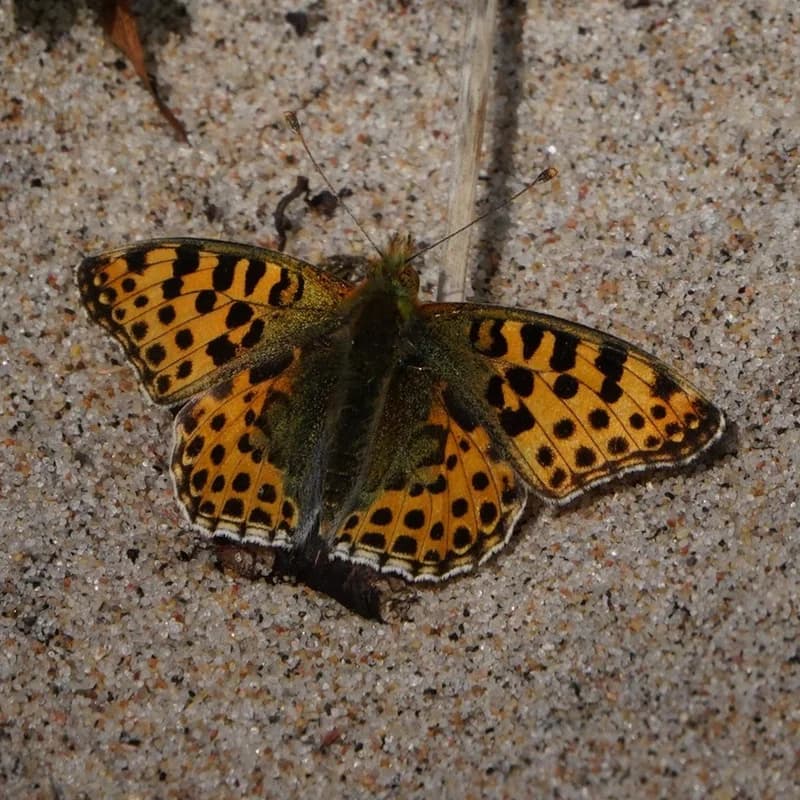
A medium-sized fritillary with a wingspan of 34–52 mm; the female is noticeably larger than the male. The upperside has a somewhat paler ground colour than the other large Norwegian fritillaries, with relatively large, round black spots that do not merge into lines. The forewings are slightly sickle-shaped with a slightly extended tip. The hindwing underside has a characteristic pattern: about six large, teardrop-shaped, silvery-white spots near the base, then a wavy white transverse band, a row of small silver spots with broad brown borders, and finally a row of six to seven large silver spots at the margin.
Similar species
It can be distinguished from other Norwegian fritillary moths by the silver spots on the underside of the hindwings; misidentification is unlikely for someone who has observed the underside.
Distribution
In Norway, I found it as far north as Snåsa in Nord-Trøndelag, but it’s found in relatively few places. The most thriving populations seem to be in dry, sunny locations in Gudbrandsdalen and Ottadalen; it also occurs relatively stably in some areas near Oslofjorden, often on beaches and sand dunes. It requires relatively warm summers and disappears easily from areas during colder periods, but can recolonize those areas later since it travels quite a bit.
Biology
The larvae live on violet (Viola tricolor). The larva is black with two white longitudinal stripes, covered in long, branched thorns. The species is sensitive to cold and rainy summers, which may be due to having two generations per year.