
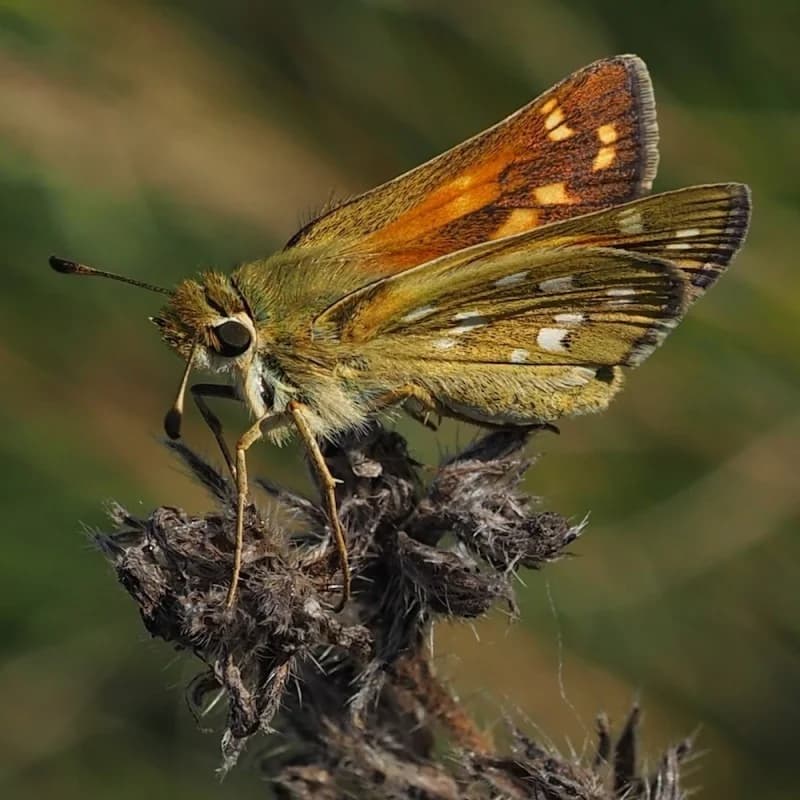
Identifying features
Wingspan 25–32 mm. The wings’ base colour is yellowish-brown with strong brown-grey dusting, most prominent towards the edges, and light yellow or orange spots on the forewing. The male has a distinct dark scent patch with a light yellow core on the forewing. The hindwing underside is green with shimmering white spots with a dark border.
Similar species
It resembles Large skipper, but differs in the silvery-white spots on the underside of the hindwing.
Distribution
Local in low-lying areas on Eastern Norway and Southern Norway, west to southernmost Rogaland; rarely in the interior of Vestlandet. Also, in Jotunheimen and Dovre, up to around 1200 metres, and locally in Troms and Finnmark. Can be abundant in dry areas, for example, in the rainforest shadow area in Nord-Gudbrandsdalen and on Hvaler in Østfold. Approximately 740 sightings according to the publication from 2025.
Biology
The larva feeds on various grasses, especially sheep’s fescue. In the lowlands, development takes one year and the species overwinters as an egg. The mountain and northern form (Hesperia comma ssp. catena) is considered to have a two-year development cycle.