
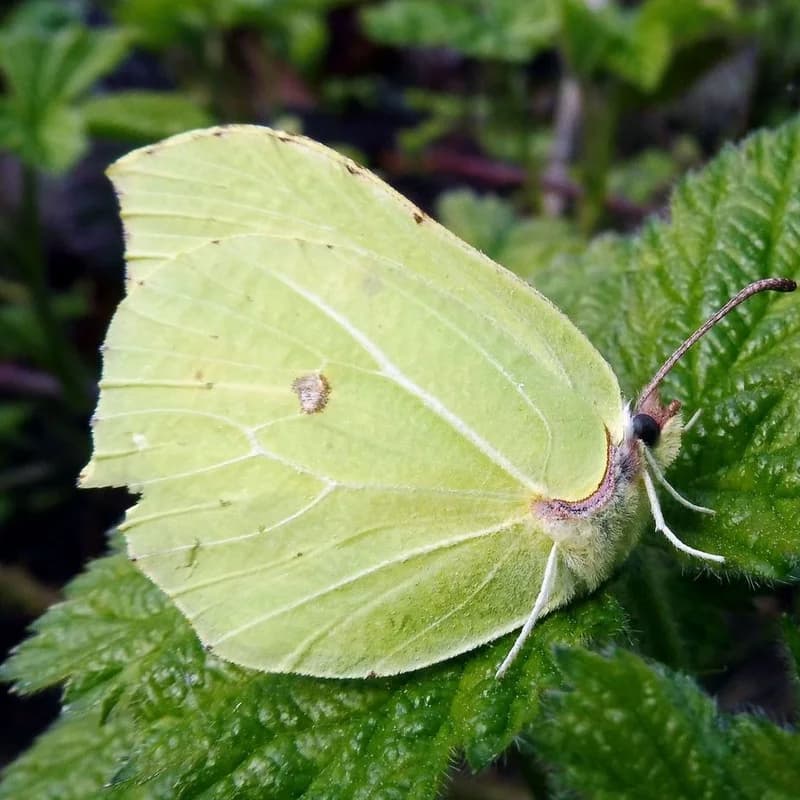
Identifying features
Wingspan 55–60 mm. The male is lemon-yellow with a small orange dot in the centre of each wing; the female is greenish-white with the same markings. The forewing tip and the middle of the outer hindwing margin extend into points. At rest, the species shows only its wing undersides.
Similar species
The female can be mistaken for a cabbage butterfly, but the species cannot be confused with any other Nordic species. The male can resemble males of Pale Arctic clouded yellow and moorland clouded yellow.
Distribution
Common in Southern Norway and the southern part of Eastern Norway. In Vestlandet and the northern part of Eastern Norway, it occurs sporadically; scattered in Trøndelag. Approximately 15,000 finds according to the 2025 publication.
Biology
Eggs are laid on alder buckthorn and common buckthorn. The larva is green with white lateral lines and grows to about 32 mm. It pupates in July on a twig of the host tree, and the adult emerges after about 2 weeks. The species overwinters as an adult in sheltered spaces, for example in stumps, tussocks and under small dense spruce trees.