
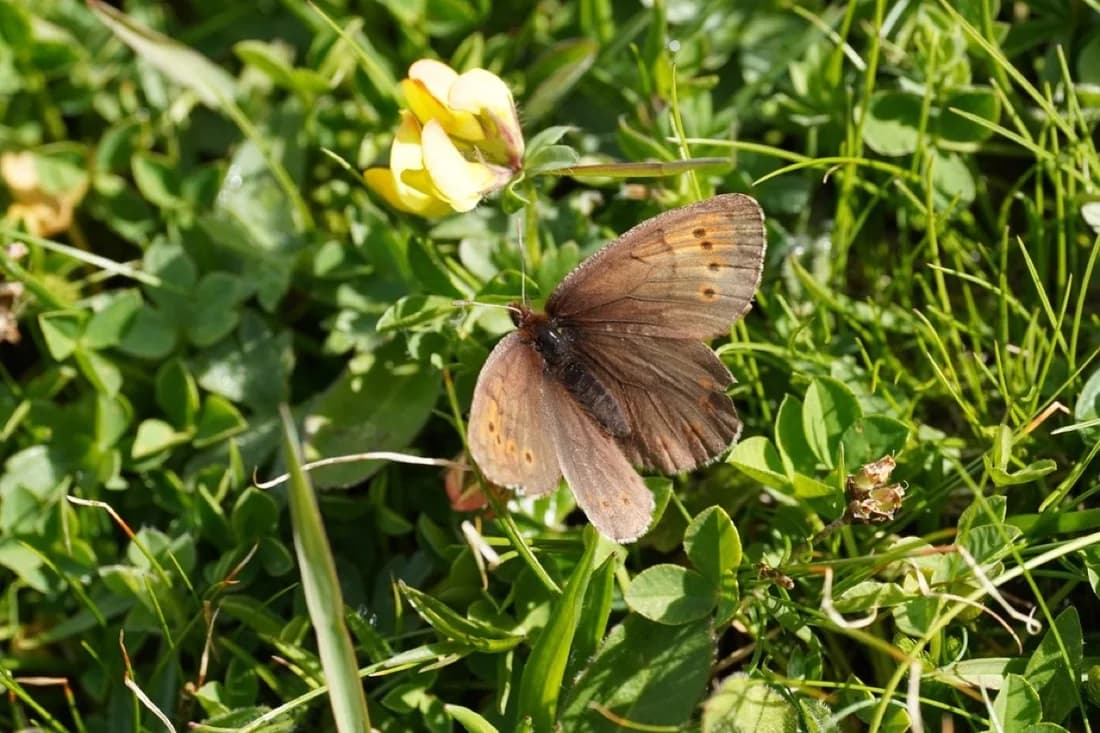
Identifying features
Medium-sized moth with a wingspan of 36–50 mm; the body is covered with long, erect hairs. The upper side is dark brown with a distinct, silky sheen. At the tip of the forewing, there is a short, orange transverse band with usually a few very small eye spots. The underside of the forewing is a lighter brown with an eye spot at the tip, while the underside of the hindwing is a greyish-brown without spots.
Similar species
Several other European species are very similar to Dewy ringlet, but none of them occur in Scandinavia. Norway can be confused with the other Erebia species, particularly arran brown.
Distribution
It almost exclusively flies above the treeline; it’s common on hills and grassy areas, at least up to 1600 metres above sea level (Southern Norway). It’s often the most numerous butterfly at that altitude, being the only butterfly seen flying there.
Biology
The larvae live on sheep fescue (Festuca spp.) and meadow grass (Poa spp.) and take two years to develop. The larvae are green and hairy, with a black dorsal line and black-spotted lateral line; the head and the two tips of the body end in a reddish-brown colour. The species spends a lot of time basking in the sun to raise its body temperature so that it can fly.