
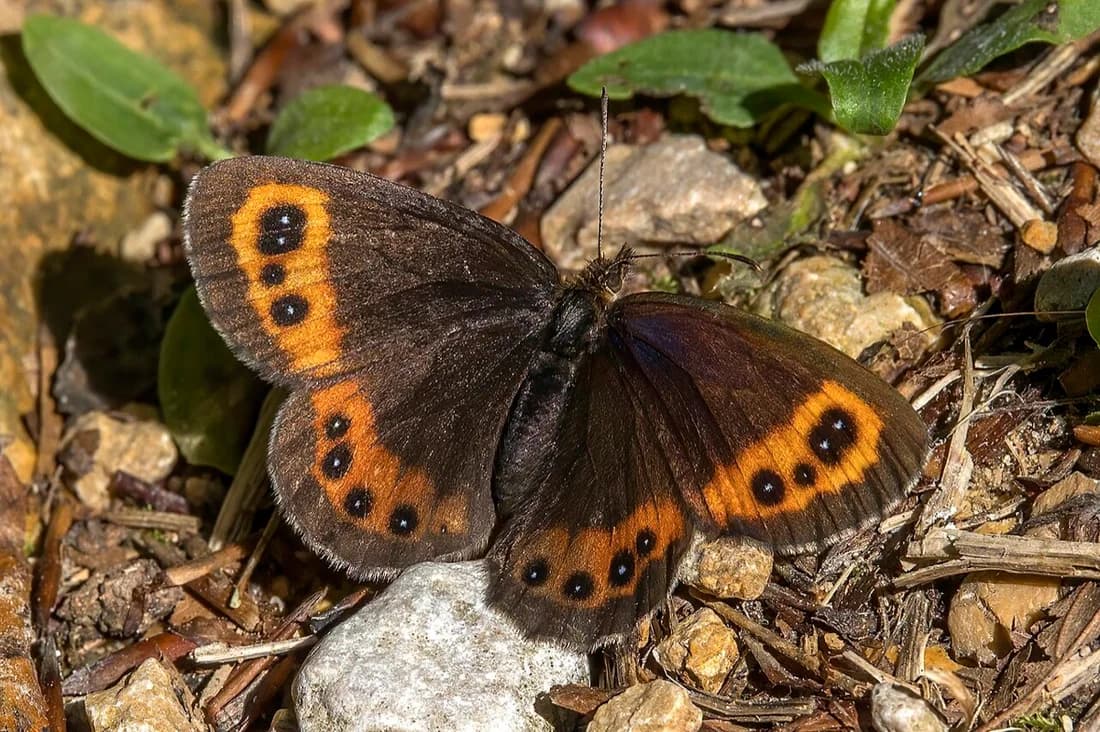
Identifying features
Medium-sized moth with a wingspan of 36–48 mm. Most of the wings are dark brown, and the species gives a very dark overall impression. On the upper sides of the wings, there is a lighter band with several small, dark eye spots. The underside of the wings has a similar pattern, but on the hindwing underside there is also a small white band. Calm and fluttering flight near the ground.
Similar species
Rather distinctive, but there are some possibilities for confusion depending on where you are and the date. The other four species in the Erebia genus (Norway) should be noted: Lapland Ringlet, Disa Alpine (Erebia disa), Dewy ringlet, and woodland ringlet (Erebia medusa).
Distribution
Common in and around open woodland in all Norwegian counties, but in eastern Finnmark known only from Sør-Varanger. Also frequent in the birch belt, reaching 1 400 metres above sea level in Jotunheimen. Nearly 9 400 records. The species is doing well in most of its European range.
Biology
The larval food consists of grass species and star species, but for Norway, it is not known which ones. Overwinters as a larva in various stages during the species’ two-year life cycle. The two-year cycle is believed to be an adaptation to avoid attacks from parasitoids with one-year development, and therefore the species may occur in smaller numbers – or be absent – in the same area every other year. Often seeks nectar from goldrush, but also a variety of other plants.