
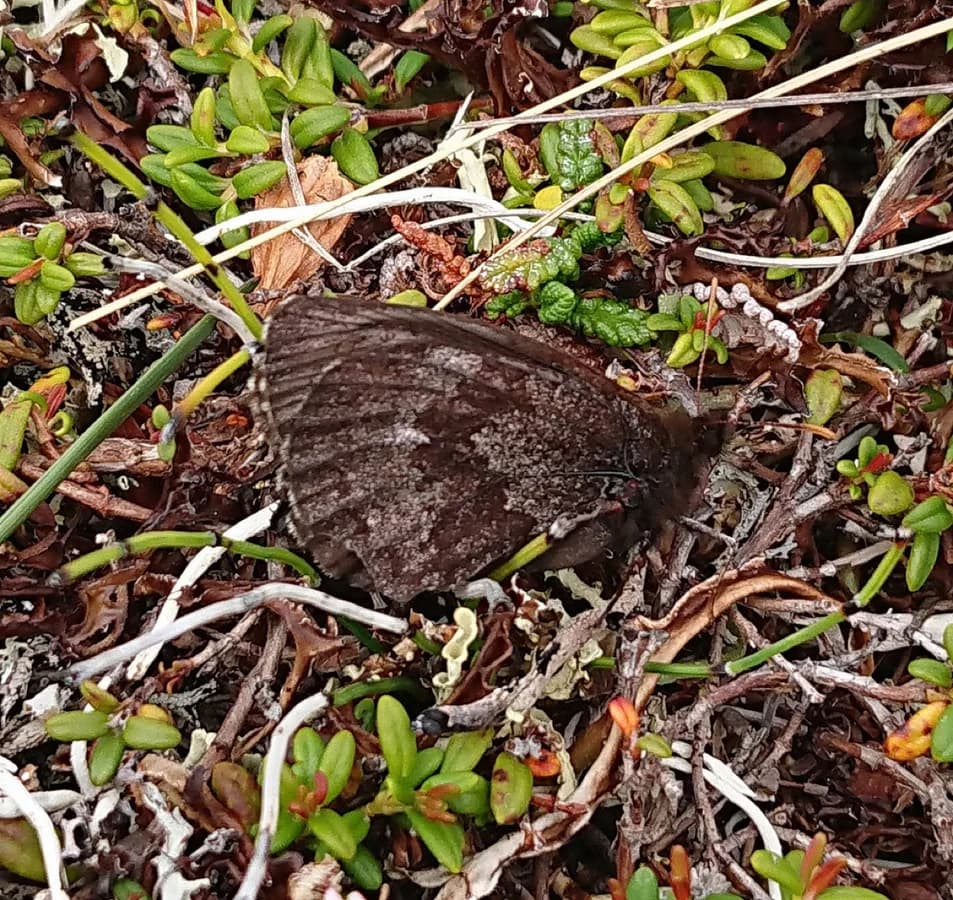
Identifying features
Wingspan 42–48 mm. The wing’s upper side is dark brown. The forewing has a row of eye spots which are almost always without a central area and have a wide, brown-yellow ring. The hindwing lacks eye spots entirely. The underside is grey-brown with a typically clearer brown cross-band. Occasionally, a white spot can be found in the middle.
Similar species
The species can be confused with Lapland Ringlet, but this one almost always has eye spots on the upper side of the hindwing, and a double eye spot at the top of the upper side of the forewing.
Distribution
Northern Europe, Kola, on the tundra east to the Bering Strait, mountain ranges in Siberia and northern Mongolia. In North America from large parts of Canada and Alaska. Norway: Lierne in Nord-Trøndelag, Saltdal in Nordland, and large parts of Finnmark. It is lacking in the northernmost and westernmost parts of Finnmark and is not known from Troms. Generally rare, but can occur in numbers within the ecosystem.
Biology
The biology is poorly known, but the larva is likely two-year-long, with grass and/or sedges (Carex) as host plants. It is ochre-green, lighter on the back, with a clear dark back line and with wide, light lateral stripes. There is an indistinct green line over the breathing holes and along the feet. The head is yellow. The larva overwinters twice and becomes 35 mm long. The pupa lies on the ground between plant parts.