
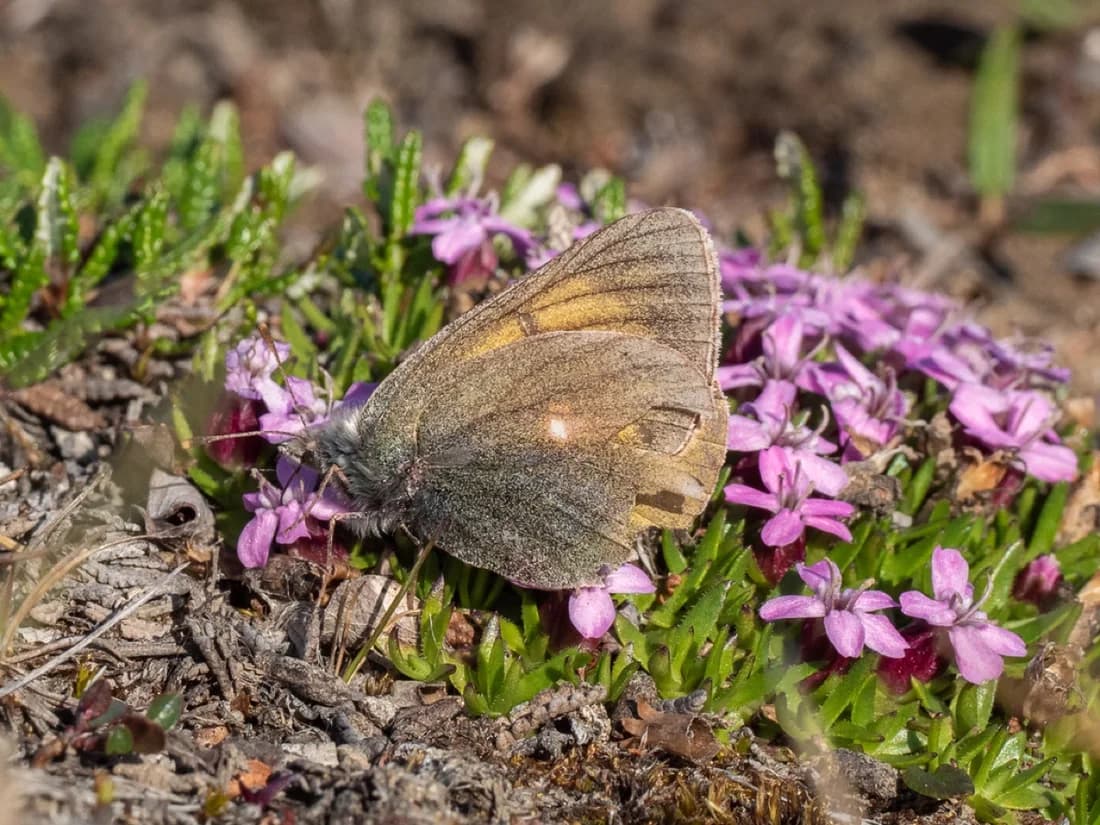
Identifying features
Wingspan 36–46 mm. Both pairs of wings have an orange base colour with a broad brown area along the outer edge (in the female with yellow spots). The forewing has a brown central spot, the hindwing a red central spot; the hindwing has grey dusting in the female. The wings have red fringes in both sexes.
Similar species
It can be confused with common clouded yellow, but this one is larger and more sharply angled, and has never been encountered within the Hecla Sulphur distribution area. A rare yellow colour variation can resemble Pale Arctic clouded yellow.
Distribution
Commonly found in our three northernmost counties, and can occur very frequently at certain locations. Primarily associated with expanses of woodland beyond the tree line, but also found down to sea level at Porsangerfjorden in Finnmark. Approximately 560 sightings according to the booklet from 2025; it is possible that the species has completely disappeared from its original range in Norway.
Biology
The eggs are laid on Astragalus alpinus. The larva is green with yellow longitudinal stripes, has a two-year development cycle and reaches about 25 mm. Heavy grazing by reindeer can reduce flower availability and is mentioned as a threat in the literature.