
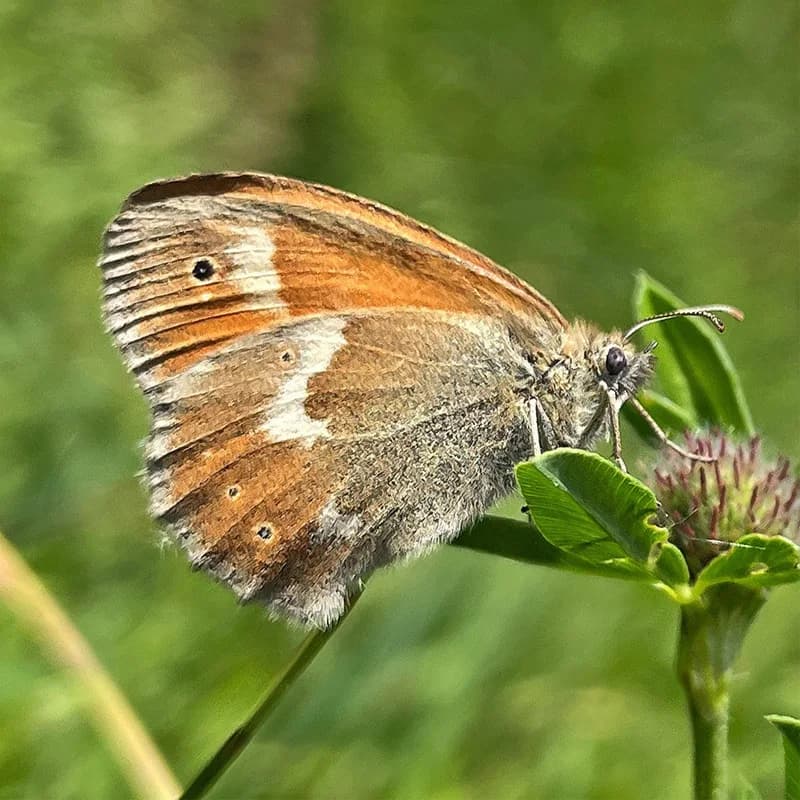
Identifying features
Wingspan 26–38 mm. The upper side of the wing is ochre-coloured with varying amounts of grey dusting. The male has a darker reddish-brown colouration, while the female is a lighter ochre-yellow. The upper side of the wings may have or may not have small eye spots. The underside is grey with an irregular white band which is often broken up into white spots. Outside of this, there are always some small spots.
Similar species
The species may be confused with small heath, but this is, on average, smaller, and the upperside is a cleaner ochre yellow with a distinct grey border, and with a grey eyespot near the apex of the forewing. The eyespots on the underside of the hindwing are, in small heath, reduced to a row of indistinct, pale spots.
Distribution
North and Central Europe, extending eastward to Mongolia and Kamchatka; widely distributed in North America. Common in suitable locations in the interior of Southern Norway, Eastern Norway, and Trøndelag. On the West Coast, it has only been found in the interior of Nordmøre.
Biology
The larva feeds on sedges (Carex), cottongrasses (Eriophorum) and several grass species. It is green, with two white lateral stripes and three darker green or reddish-green stripes. It overwinters as a larva. The pupa hangs low on a plant.