
Identifying features
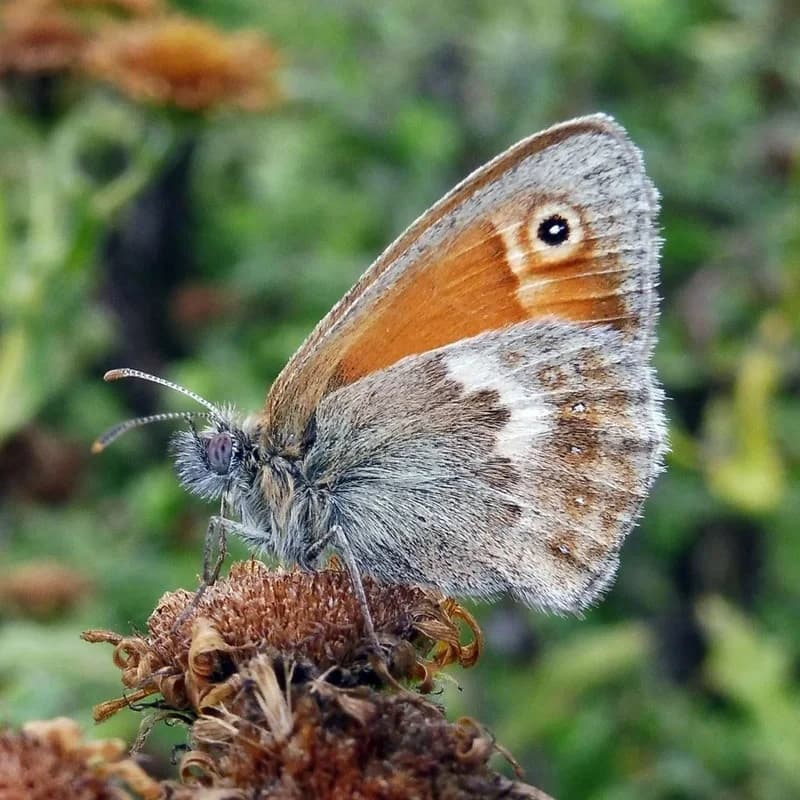
Wingspan 24–33 mm. Small and about the size of a bluebottle. The upper sides of the wings are brownish-yellow with darker edges and white all the way at the tips, and a fainter dark eye spot near the tip of the forewing. As is typical for many satyrs, only the underside of the wings is visible when the butterfly is sitting. The underside of the forewing is mostly orange or light brown, with a grey edge and leading margin, as well as a clear eye spot near the tip. The hindwing underside is predominantly grey, with a small white band or a long white spot (slightly divided), and there may also be three to four faint light eye spots. Rather calm and fluttering flight near the ground.
Similar species
The species may be confused with large heath, but this one is larger and distinctly greyish, and has small eyespots on the underside of the hindwing. Note: pay particular attention to the somewhat larger species large heath. The latter species, however, has a diffuse whitish band on the underside of each forewing, as well as only a small and paler eyespot near the tip (darker and noticeably more prominent in small heath). Furthermore, it is very rare to encounter large heath in habitats where small heath is found.
Distribution
From Europe and towards the east, up to western China. Common in Southern Norway to South Trøndelag. On Dovre, it reaches up to 1000 m. Common on dry, short grasslands from Southern Norway to the south of Trøndelag, and the species can be abundant at the location. Scattered finds further north in Trøndelag, and a find from Bremnes, located right by the coast in Bodø kommune on June 27, 2007, is the only known occurrence of the species from Northern Norway. Approximately 4700 finds.
Biology
The larva feeds on various grass species, including fescue (Poa), meadow grass (Festuca), and yellow oat grass (Anthoxanthum). Which host plants are preferred in Norway is unknown. The larva is green with three darker green dorsal lines and two broad, light-coloured lateral lines. The rear end has two reddish-brown tips. Overwintering occurs as a larva. The pupa hangs near the ground. Details: the larva's food consists of several grass species, but in Norway it is unknown which; it overwinters as a larva in various stages.