
Identifying features
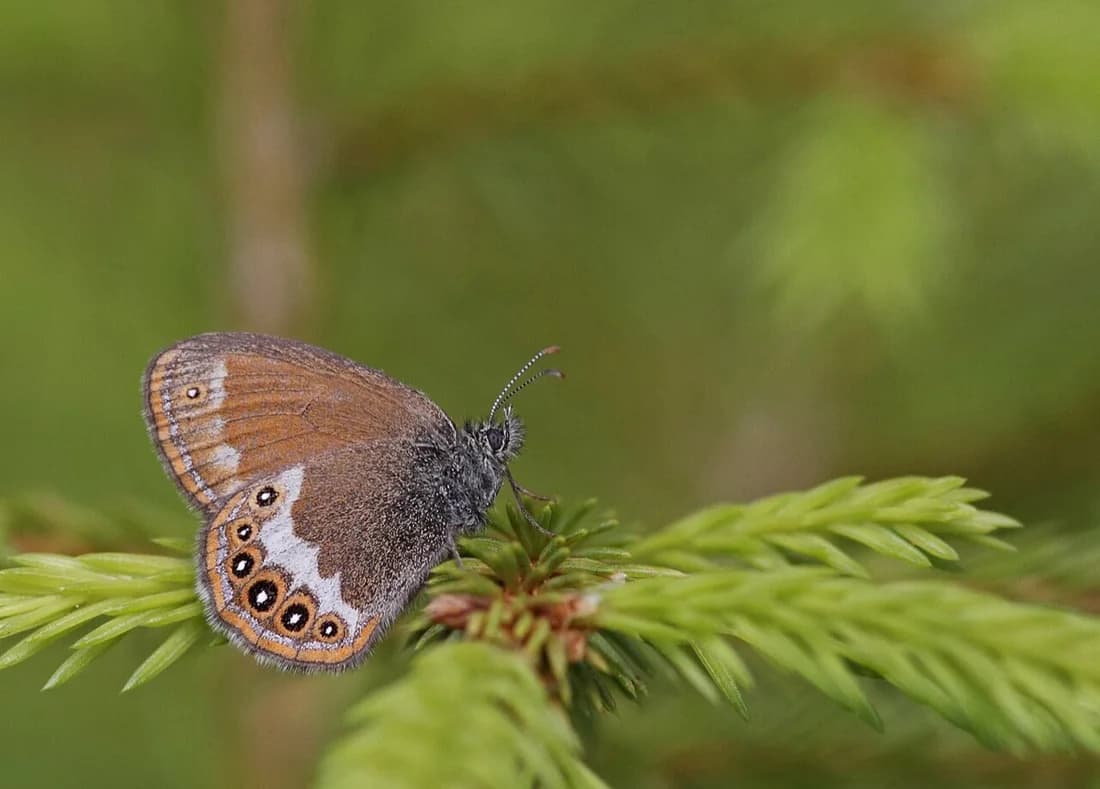
Wingspan 26–32 mm. Small, approximately the size of a blue butterfly. The uppersides of the wings are darker brown, with two to four larger, lighter-coloured eyespots on the underside of the hindwing. Females often have a greater number of, or more distinct/larger, eyespots than males, and the undersides of the wings are generally lighter. The underside of the hindwing features beautiful eyespots outside a white cross-band. As is typical for many butterflies, only the undersides of the wings are visible when the butterfly is at rest. Flight is slow and erratic, typically close to the ground. The species handbook: The upperside is dark brown; the forewing may have an eyespot near the wing tip, and the hindwing has 1-4, often indistinct, orange-tinged eyespots. The underside is dark grey-brown, and the hindwing has a white band that is edged externally with 5-6 orange-tinged eyespots.
Similar species
The booklet: pay extra attention to pearly heath which can appear in the same locations and is expanding. However, this last species has a large, bright area on the upper sides of the forewings and lighter lower sides of the forewings. Furthermore, the upper eye spot is located on the inside of the white cross-band on the hindwing underside, while all eye spots of scarce heath are on the outside of the band. Pearly heath also lacks eye spots on the wing surfaces. Small specimens of ringlet in flight resemble scarce heath.
Distribution
From northern France and southern Scandinavia, through Central Europe and further through Asia to the Amur region, Korea, and Japan. It is declining in Europe and is extinct in, among others, Denmark and the Netherlands. In Norway, it occurs in two separate areas in Østlandet: one encompassing Eidskog in Hedmark, Sørum and Aurskog-Høland in Akershus, as well as Rømskog in Østfold (a continuation of the central Swedish population; found furthest north in Bjørgedalen near Hamar); the other encompasses Nesøya, Brønnøya, and Ostøya in the western part of the Inner Oslofjord. The species was formerly common in several locations along the Oslofjord, but has experienced a significant decline. In Oslo, there have been no records since 1917, and in Vestfold, none since 1937. The majority of recent records are in Eidskog in southern Hedmark. Over 900 records. The species was protected in 2001.
Biology
The eggs are laid singly on various grass species. It is uncertain which grass species constitute the primary food source for this species in Scandinavia, but ryegrass, creeping fescue, and silverweed have been suggested. The larva is green with a dark green dorsal line, two white stripes, and a pale yellow lateral line. It grows slowly, reaching a total length of approximately 25 mm. It overwinters in the third or fourth larval instar and completes its development the following spring. Pupation occurs on a stem just above the ground. The pupal stage lasts for 2-3 weeks. Regarding the larval food source, it likely consists of several grass species, but it remains Norway unknown which; it is likely that creeping fescue is frequently utilized, and possibly silverweed as well. It overwinters as a relatively large larva in the third or fourth instar.