
Identifying features
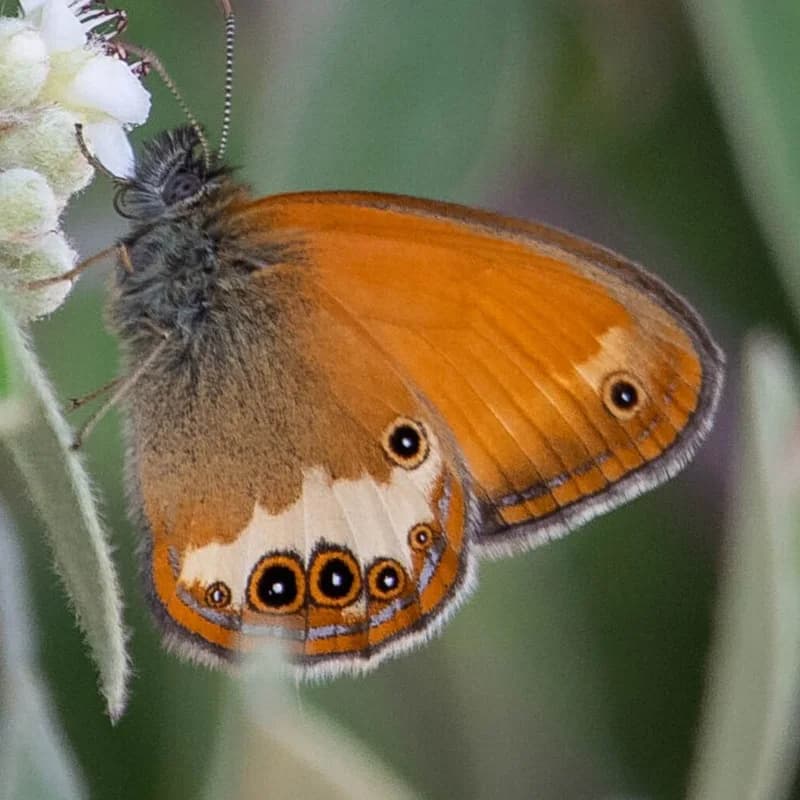
Wingspan 28–34 mm. The upper side of the forewing is yellowish-orange with a broad grey-brown outer edge. The hindwing is mostly grey-brown on the upper side. The underside of the forewing is yellowish-orange with a small eye spot near the tip, while the hindwing underside is grey-brown with a broad white band that is edged outwards with 4-6 black and yellow spotted eye spots.
Similar species
No confusing species have been described in the species handbook. The guide for scarce heath: pearly heath has a large, light area on the uppersides of the forewings and lighter undersides of the forewings; the upper eyespot is located on the inner side of the white cross-band on the undersides of the hindwings, while all the eyespots of scarce heath are located on the outer side of the band; pearly heath also lacks eyespots on the uppersides of the wings.
Distribution
Europe, excluding the northernmost areas, extending eastward to the southern Ural; absent in Great Britain. The species was long known only from Halden and Fredrikstad in Southern Østfold. Since 1970, it has spread across almost the entire Østfold region and further north in Akershus, on the eastern side of the Oslofjord. Relatively common locally.
Biology
The larvae live on hanging stems, probably also on other types of grass. It is green, with a lighter back, a dark back line, a narrow side line, yellowish stripes, and two red tips on the ventral side. It reaches approximately 25 mm in length. The overwintering occurs as a larva.