
Identifying features
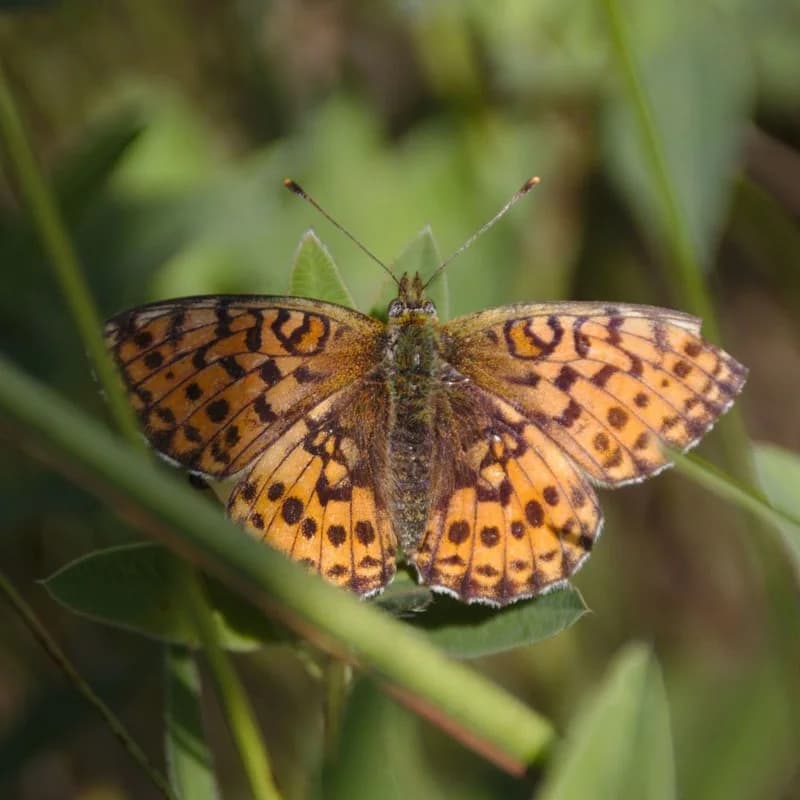
Wingspan 33–42 mm. The forewing is somewhat more rounded than in our other small fritillary moths. The upper side is orange with a relatively faint pattern of black spots, but with a strong dark edge band. The hindwing underside is yellowish-brown and lacks silver spots. There is a yellow cross-band edged with brown and cut through by brown ribs in the inner half of the wing. Outside of this is a brown or brown-purple cross-band with small eye spots.
Similar species
The yellow cross-band edged with brown on the inner half of the underside of the hindwing, and the brown or brownish-purple cross-band with small eyespots outside, according to the species handbook, makes the species relatively easy to identify; no similar species have been described in the sources examined.
Distribution
North and Middle Europe, and eastward to Japan. Quite common on Eastern Norway and Southern Norway. Scattered in Vestlandet and in Trøndelag. The species is expanding northward.
Biology
The larvae live on valerian and raspberries, or alternatively, other Rubus species. It is yellowish-brown with a double, yellowish stripe, and has a yellowish lateral stripe and black-spiked yellow thorns. It grows to 30–35 mm long. The overwintering occurs as a larva.