
Identifying features
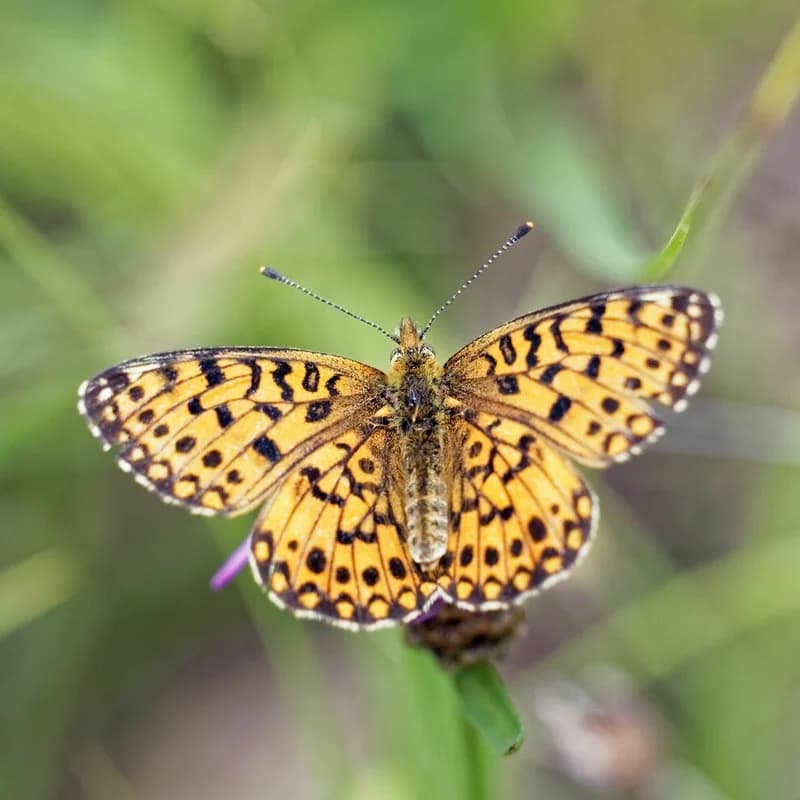
Wingspan 34–44 mm. A medium-sized pearl-bordered fritillary. The uppersides of the wings are light brown with numerous black markings, and the undersides of the forewings are somewhat similar (though with an even lighter background colour). The underside exhibits shades of yellow and brown, with several silvery-white patches, including a distinct silvery-white spot in the centre and a row of silver spots along the outer edge. The brown area within the central spot has a black dot. Characteristic features of the undersides of the hindwings include pointed triangular patches at the outer edge, two diffuse brown patches within, and typically a larger black dot near the wing base. Individuals in a second generation are smaller, and the same applies to individuals found in the north.
Similar species
The species is very similar to Pearl-bordered Fritillary, but the two species can be distinguished by the markings on the underside of the hindwing. small pearl-bordered fritillary has orange-brown or hazel markings on the underside of the wing, with no clear red highlights. The brown/yellow spots that form a semicircle at the base of the wing are, in Pearl-bordered Fritillary, warm orange-red. Small pearl-bordered fritillary has several silver spots, and the spots along the edge of the wing are internally defined by sharp, dark angles, whereas in Pearl-bordered Fritillary they are defined by diffuse, brown triangles. The booklet also mentions Bog Fritillary and Lesser Marbled Fritillary (Brenthis ino) as confusing species.
Distribution
Europe and eastward to Magadan and Kamchatka, as well as North America. Common throughout the country, also in the mountains. Common in open areas with fresh/moist meadows throughout Norway, from lowlands to the highlands. Can be abundant on clear-cutting areas and in power line routes. Unlike Bog Fritillary and Pearl-bordered Fritillary, the species is not commonly found on bogs. Approximately 4900 sightings distributed across all of Norway’s counties. Has decreased in lowlands in several countries in Europe, related to changes in agriculture.
Biology
The larva feeds on violets (Viola). It is grey-black with a diffuse, lighter grey dorsal stripe. The branched spurs are brown or dark brown, and the two foremost spurs are long and forward-pointing. In most cases, overwintering occurs in the larval stage; in some instances, it occurs as a pupa. Adults feed on nectar from plants including Geranium sylvaticum and thistles.