
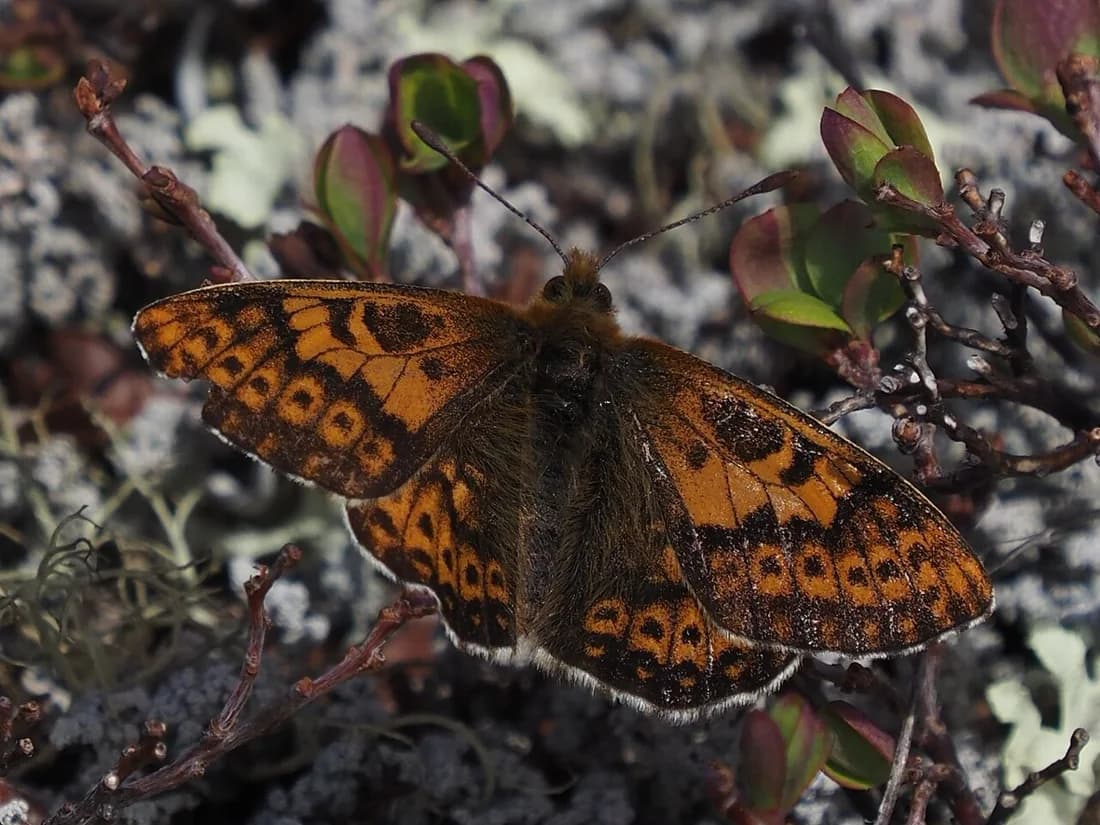
Identifying features
Wingspan 34–43 mm. The upperside of the wings is a pale yellow-brown with a pattern of black spots. The underside of the hindwing is dominated by reddish-brown bands and spots edged with white. The white spots along the outer edge of the wing are "T"-shaped. This feature distinguishes the species from similar species such as Purplish Fritillary and Freija Fritillary.
Similar species
The white spots along the edge of the wing are “T”-shaped, which distinguishes the species from similar species such as Purplish Fritillary (oval silver spots) and Freija Fritillary.
Distribution
Circumpolar. Northern Europe, Arctic areas of Asia, Greenland, and northern North America. From Saltdalen in Nordland, through the interior of Troms, to Finnmark. Generally rare and found in isolation, but sometimes found in abundance at locations.
Biology
The early life stages are very poorly understood, and the host plant for the larva has not been identified, but Dryas octopetala may be one of the host plants. Larvae hatched in captivity have not shown a willingness to feed, and it is likely that the larvae will overwinter before they begin to eat.