
Identifying features
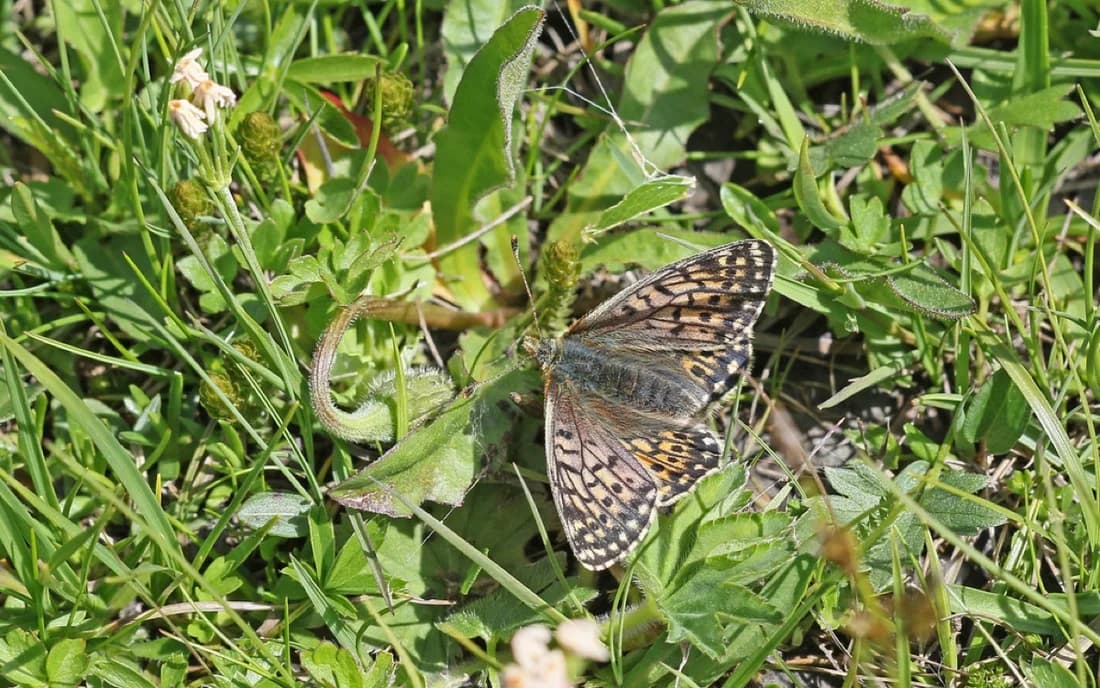
Wingspan 31–43 mm. The upper side of the wing is orange with most often a faint pattern of black spots and lines. The underside of the hindwing is in yellow and brown patches with some indistinct silver spots and with a clear silver spot in the middle. The species differs from most other Boloria species by the fact that both forewings and hindwings are less rounded, with a clear “corner” in the middle of the outer edge of the hindwing.
Similar species
It shares these characteristics with cranberry fritillary, and the separation of these two closely related species may present challenges. The following characteristics will be helpful: The black spots on the upper side are thinner and more linear in Mountain fritillary. On the underside of the forewing, these same spots are reduced, sometimes to faint shadows, while they are prominent in cranberry fritillary. The underside of the hindwing often has more silver spots and a deeper red colour in cranberry fritillary than in Mountain fritillary, which is always yellowish.
Distribution
Circumpolar. Northern Europe, the Pyrenees, the Alps, and mountain ranges as far east as the Amur; the northern part of North America. Relatively common in the mountains from inland Rogaland to Finnmark. Also common in low-lying areas, as far north as possible.
Biology
The larva lives on violets (Viola), particularly mountain violet, but also on hare’s-foot clover. It is brown-grey with two yellow lines along the back, along a dark central line. It has brown fur and meat-coloured thorns. The larva overwinters up to twice.