
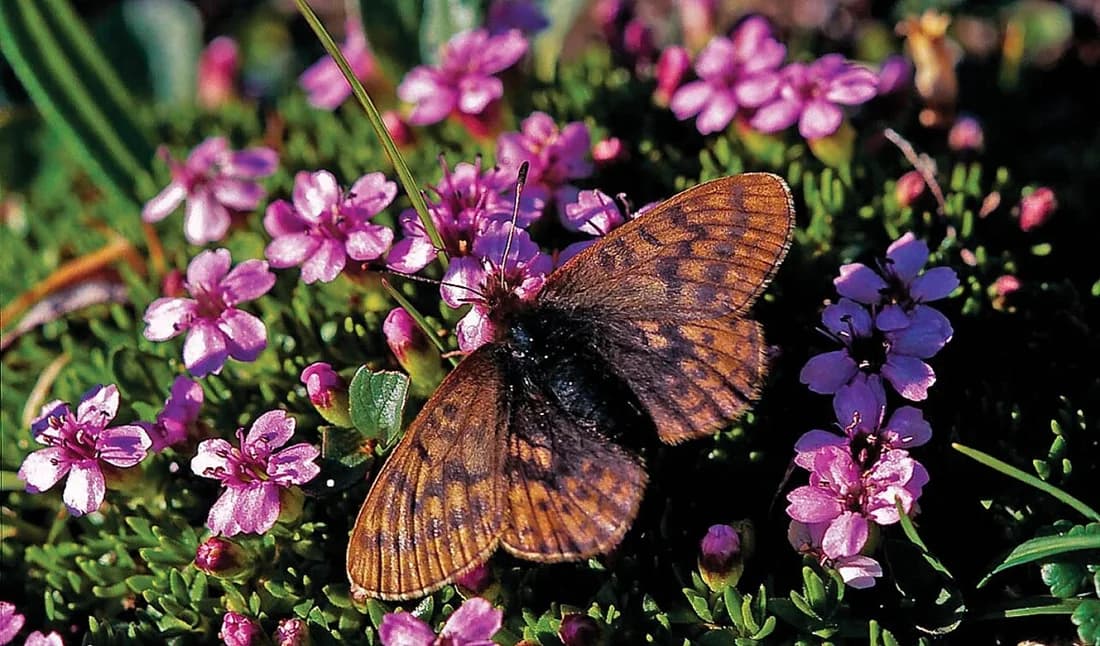
Identifying features
Wingspan 26–36 mm. Norway’s smallest and darkest fritillary, in size comparable to our largest blue-winged species. Both the upper and lower sides of the wings exhibit a strong brownish-grey dusting, obscuring the typical fritillary pattern. The hindwing underside is diffusely brownish-grey in the outer half, while the inner half is a darker brown with a lighter transverse band. This band has two white-grey spots in the middle and an additional one at the wing’s edge.
Similar species
This species is unlikely to be confused with any other, particularly for those who have studied illustrations of the species. The species most similar in appearance is the much larger Frigga Fritillary, but it is found at lower elevations and not within the altitudinal range of Dingy Fritillary in the mid-alpine zone. It may initially resemble a smaller specimen of Dewy ringlet Erebia pandrose, a species that can also be found in the same areas. The species handbook: The underside of the hindwing appears as a less distinct version of the hindwing of Frigga Fritillary, but due to its modest size and predominantly grey colour, the species is unlikely to be confused with other species.
Distribution
Circumpolar. Northern Europe, Novaja Semlja (Newfoundland), Canada, Alaska, and the northern part of the Rocky Mountains; likely widespread in northern Siberia. Norway is known only from a few locations in central Troms: the municipalities of Bardu, Målselv, Storfjord, and Kåfjord, with an uncertain finding from Kvænangen in 1960. Very rare. A distinctly high-altitude species, primarily found at around 1000 metres above sea level, up to approximately 1200 metres.
Biology
The larvae live on privet and, probably also on mouse ears. It overwinters twice. Before the final overwintering, it is blackish-brown with black lines along its back, densely hairy, and with black thorns. The black head has two thorns. The pupa does not hang freely as it does in other fritillary species, but lies horizontally between loosely interwoven leaves. The life cycle is two-year.