
Identifying features
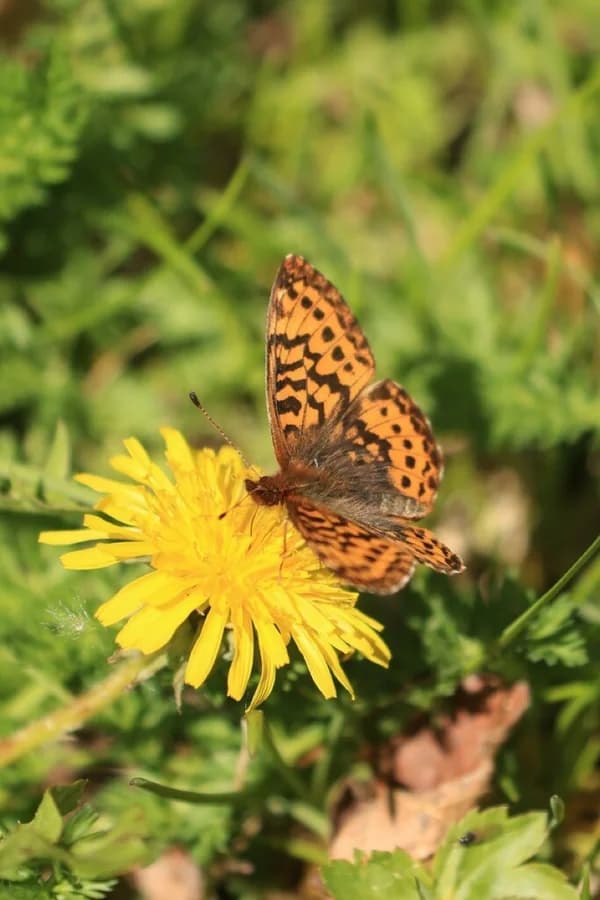
Wingspan 38–48 mm. The largest of the Boloria species. The upperside of the wings is orange, though relatively dark, with a coarsely patterned arrangement of black spots. The underside of the hindwing is grey-violet in the outer half, with an indistinct pattern. The inner half is reddish-brown. A transverse band of light spots, located approximately in the middle, is partially filled with yellowish-brown and reddish-brown, but features two white spots in the centre and a large white spot along the leading edge.
Similar species
The underside pattern can resemble that of Purplish Fritillary and Thor’s fritillary, but is predominantly darker and less contrasted. Dingy Fritillary has a very similar underside pattern, but this species is easily recognisable by its modest size, grey-brown colour, and flowing wing pattern.
Distribution
Circumpolar. From Northern Europe and eastward through Northern Russia to Amur and Kamchatka. Widely distributed in Canada, it extends south through the Rocky Mountains to Colorado. Found in the inner and eastern parts of Eastern Norway and in the eastern parts of Trøndelag. It is also found in the inner Troms and in Finnmark. The species is very localised, but can be abundant at certain locations.
Biology
The larvae live on mulberries. After overwintering, it is black with four white, partly broken longitudinal lines that eventually merge together. Each segment has six brown thorns.