
Identifying features
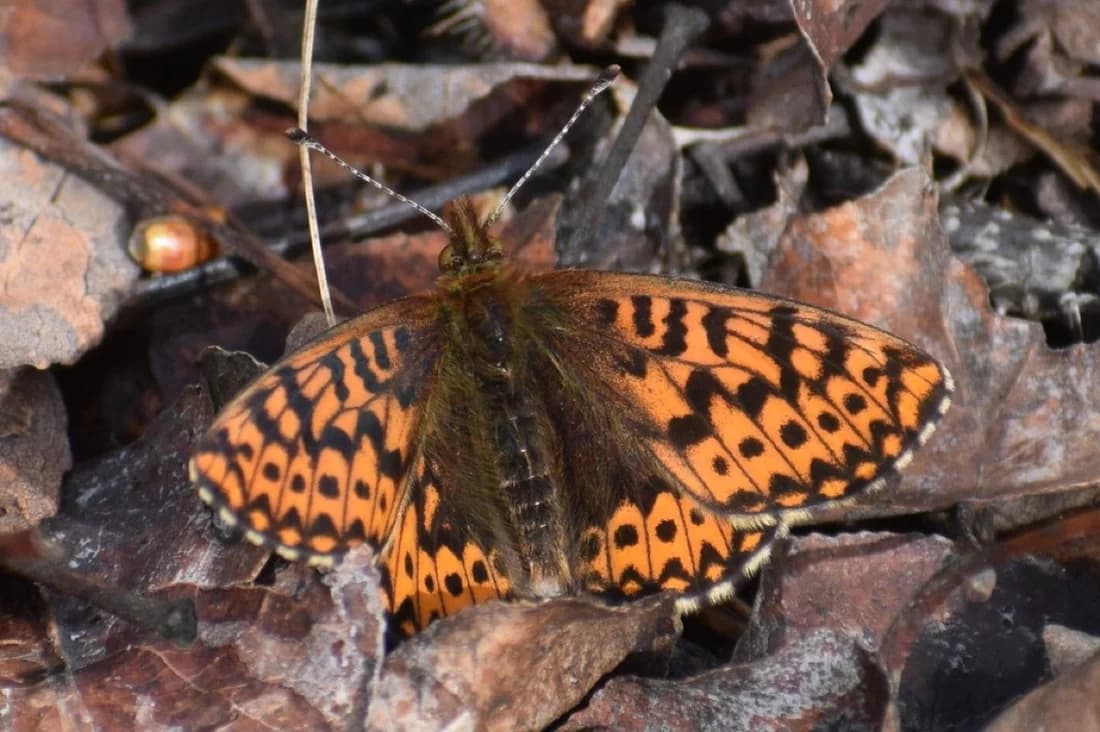
Wingspan 34–44 mm. The upper side of the wing is relatively light yellowish-brown with a rough pattern of black spots. The underside of the hindwing has a mottled pattern mainly in brown and silvery-white with strong black lines. The large spots forming a band in the middle of the wing are largely filled with rust-red, and are edged outwards with strong, jagged black lines in a zigzag pattern. The underside pattern is more mottled than that of our other small fritillary moths.
Similar species
No confused species are described in the examined sources.
Distribution
Circumpolar. From Northern Europe and eastward through Siberia to Kamchatka and Japan, and further eastward to northern North America. In the Rocky Mountains south to Colorado. Locally in low-lying areas at Eastern Norway. Otherwise, widespread in higher elevations at Eastern Norway, in the interior of Trøndelag, Nordland, and Troms, as well as throughout Finnmark.
Biology
The larva feeds on cloudberry, cranberry and bog rosemary. Bog bilberry, bilberry and alpine bearberry are also mentioned as host plants. It is grey-black with black spines and a broken grey lateral line. It overwinters as a fully grown larva and pupates in spring. The pupa hangs low in the vegetation.