
Identifying features
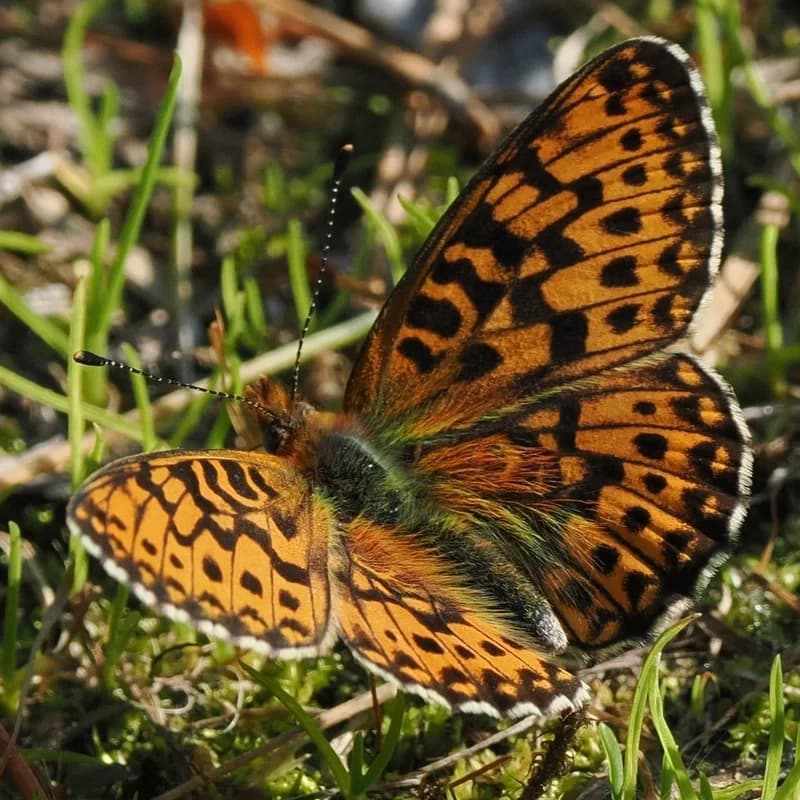
Wingspan 31–45 mm. The upper side of the wing is orange with black spots. The underside is in yellow and brown mottled patterns, with a clear silver-white spot in the middle and a line of silver spots along the outer edge. The reddish area within the central spot has a black dot. In the outer half of the wing, there is a line of diffuse brown-black spots.
Similar species
The species is very similar to small pearl-bordered fritillary, but the two species can be distinguished by the markings on the underside of the hindwing. Pearl-bordered Fritillary displays the entire underside of the hindwing in a more reddish shade. The warm orange spots that form a semicircle at the base of the wings are brownish or yellowish in small pearl-bordered fritillary. Pearl-bordered Fritillary has fewer silver spots, and the spots along the edge of the wing are delimited by diffuse, brownish triangles, whereas those in small pearl-bordered fritillary are delimited by black, sharply marked angles.
Distribution
Europe and eastward to Amur and Kamchatka in East Siberia. Common throughout the country, also in the mountains.
Biology
The larva lives on violets (Viola), and it is likely to live on bog bilberry in moss. It is black with light spots forming two rows along its back and is equipped with black, branched thorns with a golden base. There are two additional, long thorns behind the head. The overwintering occurs as a young larva. The pupa hangs low on plants.