
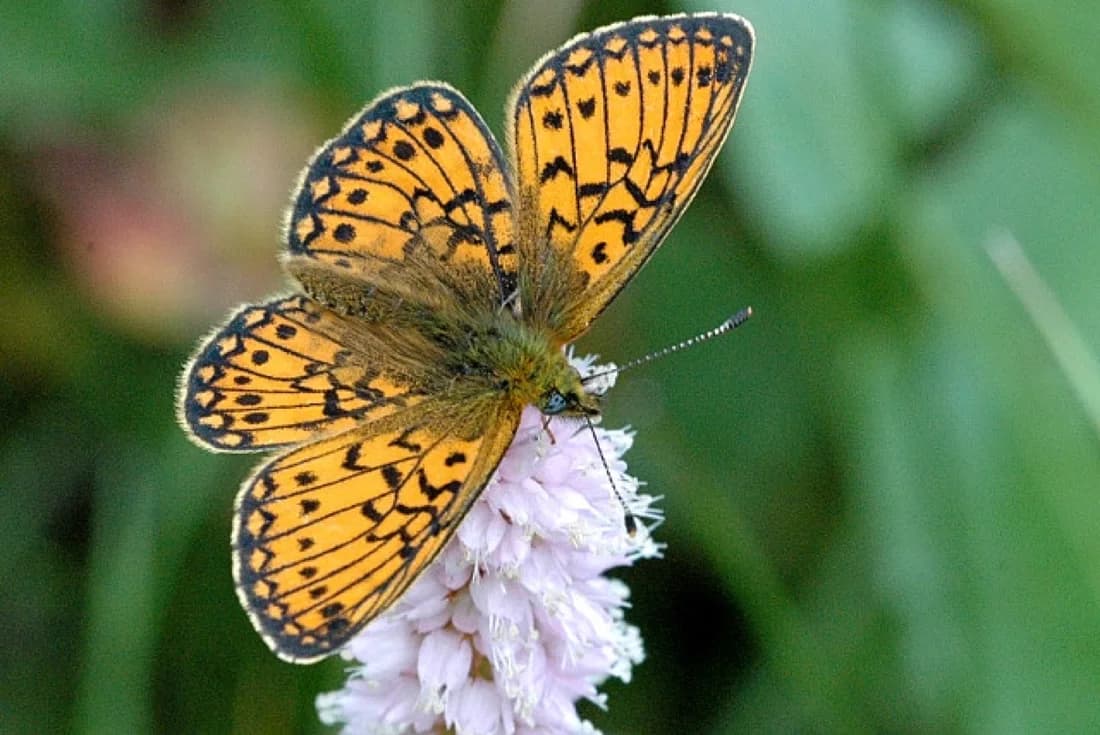
Identifying features
Wingspan 29–40 mm. The wing’s upper side is orange with black spots. The underside of the hindwing is in yellow and red patterns, with black veins and a row of silver spots along the outer edge. Within these, there is a row of light rings with a black border. These rings distinguish the species from all our other fritillary moths.
Similar species
The markings on the wing uppersides alone are barely sufficient to distinguish this species from closely related species such as pearl-bordered fritillary and small pearl-bordered fritillary. Reliable identification requires examination of the hindwing underside.
Distribution
Scattered occurrences in West Europe. From North and East Europe, the distribution extends to eastern Siberia. In North America, from Labrador to Alaska and to Colorado in the Rocky Mountains. Locally common in inland areas from Åmli in Aust-Agder to Porsanger and Sør-Varanger in Finnmark. Absent in coastal areas. On the West Coast, it is found only in Eidfjord in Hordaland and Sunndal in Møre og Romsdal.
Biology
The larva is likely feeding on cranberry and myrtle violet. It is brown with many white spots, and has a pale yellow line along its back and feet, as well as orange thorns. The overwintering occurs as a larva. The pupa hangs on a decaying stem near the ground.