
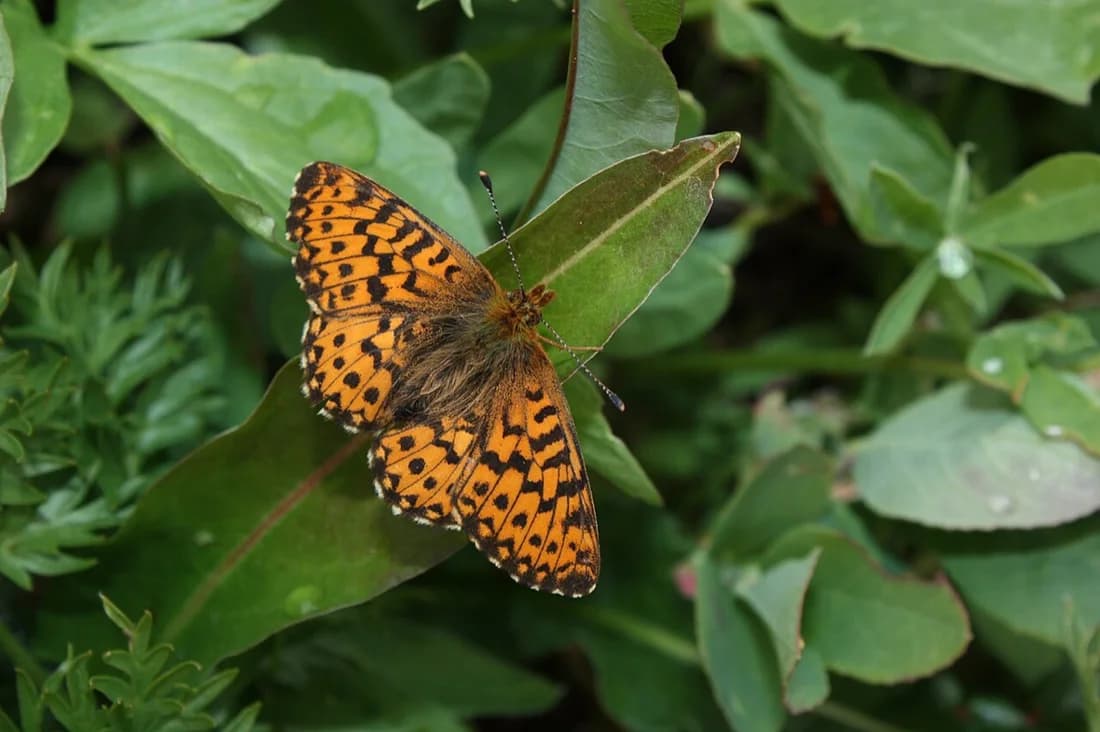
Identifying features
Wingspan 35–43 mm. The upper side of the wing is warm reddish-yellow-brown with black spots. The underside of the hindwing is brown-red with a lighter transverse band on the inner side, and with silver-white spots along the outer edge and in the lighter transverse band. Within the edge spots, it has a row of brown spots. The outer silver spots are oval, not T-shaped as in Arctic Fritillary.
Similar species
The species is characterised by the reddish-brown pattern on the underside of the hindwing, with silver-white spots. The outer silver spots are oval, not T-shaped as in Arctic Fritillary. It may also be confused with cranberry fritillary, but this species has a more angular shape to the hindwing, fewer silver-white spots on the underside of the hindwing, and the silver spot in the middle of the wing is less pointed outwards.
Distribution
Arctic Europe, Siberia, Greenland, and the northernmost part of North America. Occurs locally in the interior of Troms and across most of Finnmark. Avoids the westernmost, most rainfall-prone areas.
Biology
The larva’s food plants are uncertain, but probably include Arctic white heather and net-leaved willow. It overwinters immediately after hatching, without feeding first, and may then overwinter a second time as a fully grown larva. It is grey-black with a double grey-white dorsal line, an indistinct grey-white lateral line and grey-white spines. The pupa hangs attached to a stone.