
Identifying features
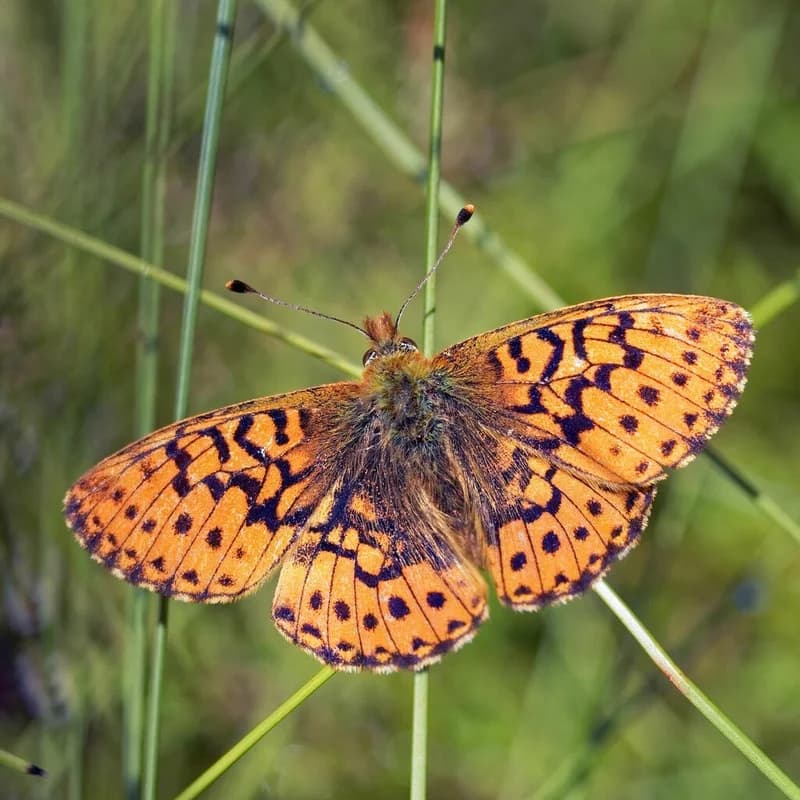
Wingspan 29–37 mm. The forewing upper side is orange with a pattern of black spots and lines. The hindwing underside is in shades of yellow and brown with some silver spots and with a clear silver spot in the middle. This species differs from most other Boloria species by having both forewing and hindwing less rounded, with a clear “corner” in the middle of the outer edge of the hindwing.
Similar species
It shares these characteristics with Mountain fritillary, and the separation of these two closely related species may present challenges. The following characteristics will be helpful: The dark spots on the upper side are more prominent and less streaky in cranberry fritillary. The same spots are visible on the underside of the forewing, while they are often faded in Mountain fritillary. The underside of the hindwing often has more silver spots and a deeper red colour in cranberry fritillary than in Mountain fritillary, which is always yellowish.
Distribution
North and Central Europe, eastward to western Siberia; the northern parts of North America. Common throughout the country.
Biology
The larva lives on cranberry and bog rosemary. It is dark brown, densely covered on the sides with white-yellow spots that form indistinct lateral stripes. There are two clear, narrow dorsal stripes. It has many yellow, branched thorns with an orange extension at the base. Overwintering occurs as a larva.