
Identifying features
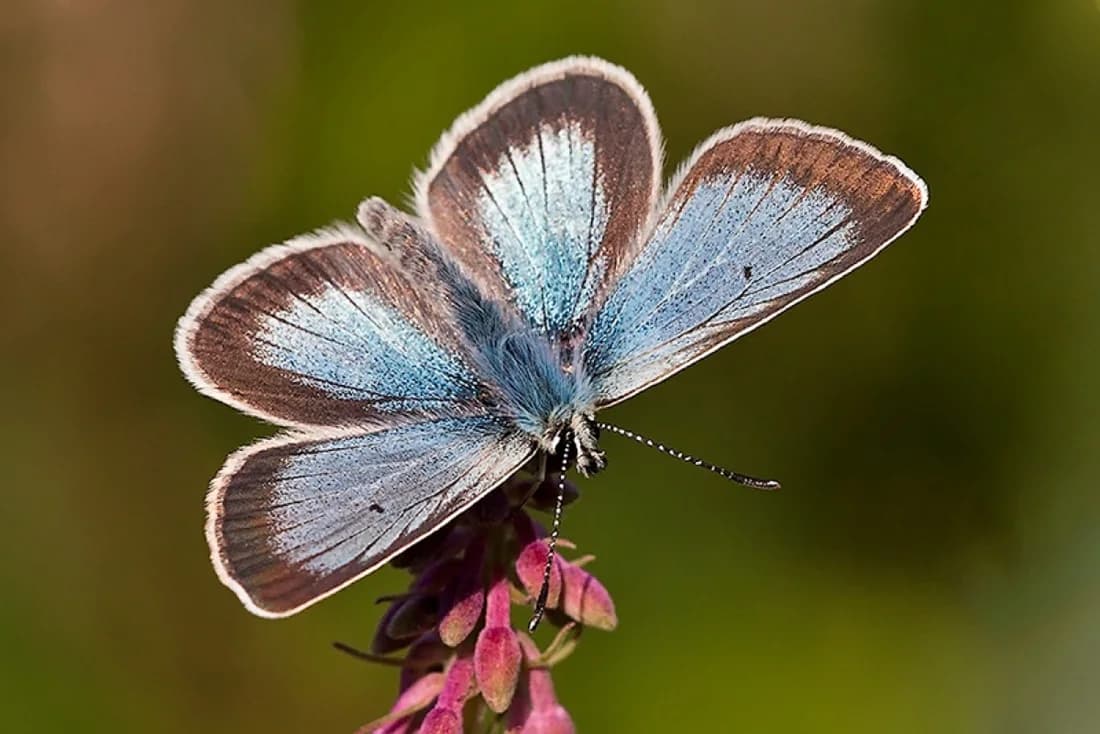
Wingspan 25–28 mm. The male has a bright, almost turquoise-blue dorsal wing surface with a dark, sharply defined black area within the wing margin; the female is dark, uniformly brown without markings. The ventral wing surface is grey with small dark spots within narrow white rings, and a white wedge extends from the hindwing margin towards the centre of the wing, slightly beyond the discal spot. Near the base of the wings, there is a dark blue-black area.
Similar species
Can be confused with Geranium argus, which often occurs in large numbers at the same sites in Trysil. Geranium argus reaches the end of its flight period when Silvery argus is well into its flight period in mid-July (according to the booklet).
Distribution
The first discovery of Norway was made in Trysil in 2006 (common blue butterfly, number 99 observed in the country), and the species has not yet been found outside that municipality – but it has been found at several locations there, with a good population observed in 2024. Classified as strongly threatened (EN) due to a limited distribution area combined with ongoing decline in habitat quality.
Biology
The bog wood beetle is the only larval food source. Silvery argus overwinters as eggs, while Geranium argus overwinters as larvae. The species cannot survive on intensively managed pastures with heavy fertilisation and mowing, and is vulnerable when old meadows regenerate.