
Identifying features
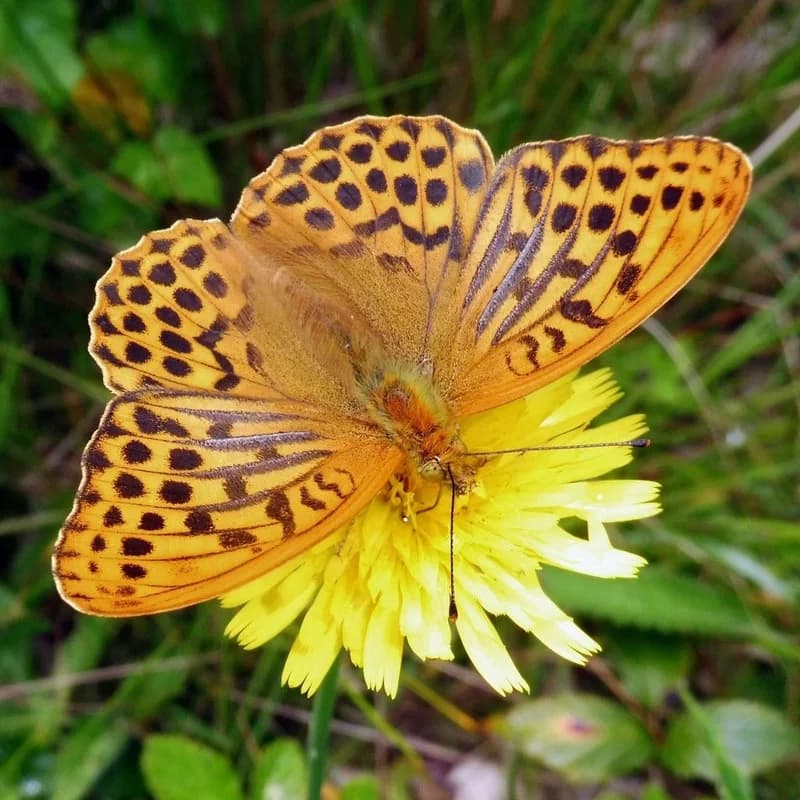
Wingspan 53–65 mm. Our largest fritillary, and easily recognisable on the underside of the hindwing, which is green with silver stripes. The male’s upper side is deep orange with black spots, and the forewing has broad, black scent scales on rib 1-4 from the rear. The female’s upper side is orange with large black spots and often with clear dark dusting.
Similar species
No confused species are described in the examined sources.
Distribution
Europe, North Africa, Little Asia, the Caucasus, and eastward to Japan and Korea. It is locally common around the Oslofjord, along the Southern coast, and in the interior of Telemark. In more recent years, the species has become more abundant and has expanded westward to Rogaland, as well as inward into the country in Southern Norway.
Biology
The female lays eggs in cracks in birch bark. The newly hatched larvae overwinter in the bark. In the spring, they descend to the ground where they feed on violets (Viola). When the larva reaches its adult size in June, it measures 43 mm. It is dark brown with faint yellow side stripes and two yellow back stripes, and is equipped with many long, orange thorns with black side thorns. The brown pupa hangs from decaying branches or similar.