
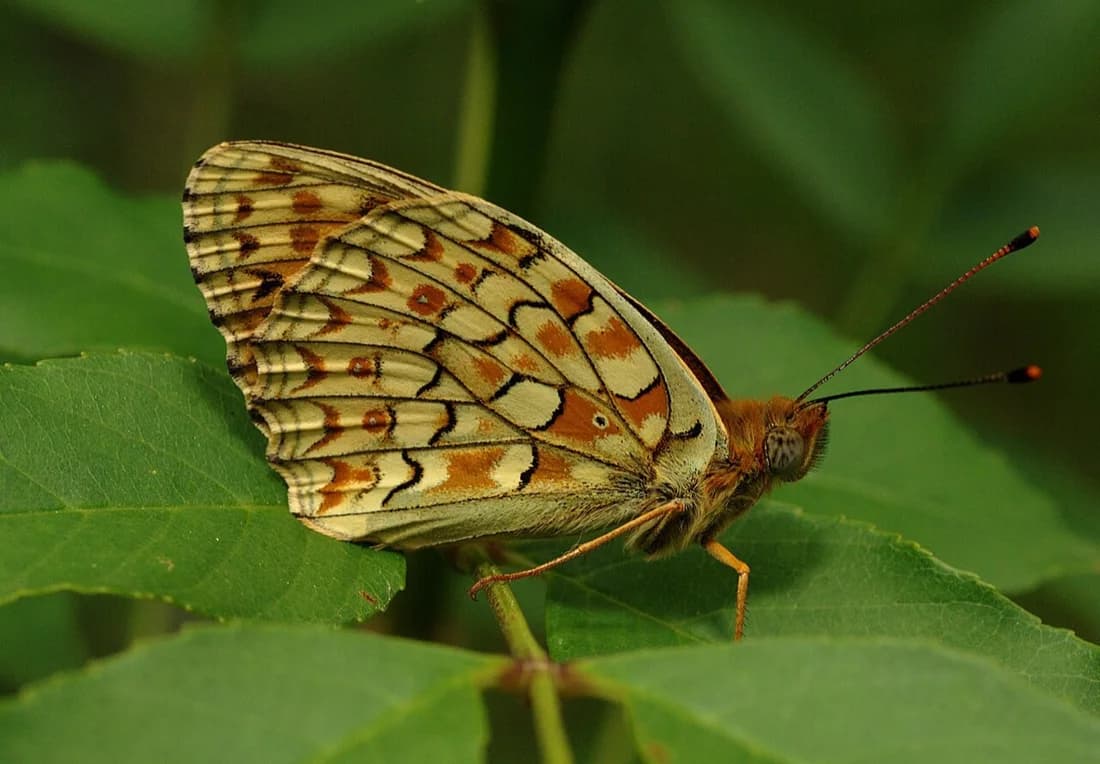
Identifying features
Wingspan 41–52 mm. One of our four largest fritillary beetles. The upper side of the wing is orange with black spots and fine black veins. In the male, the veins of the forewing are weakly thickened 2+3 from the rear, with scent scales. The underside of the hindwing is yellow with green and brown blotches and has several large spots, which are usually yellow, but occasionally silver-coloured. Along the edge there is a row of rust-red eye spots, a characteristic that distinguishes the species from Dark green fritillary.
Similar species
The species is very similar to High brown fritillary, and the only reliable distinguishing feature is the scent ridges on the male’s thorax, which, unlike in Niobe fritillary, are not significantly enlarged. Otherwise, the species can be distinguished from High brown fritillary based on the following characteristics: wing span, average 41–52 mm; the outer edge of the forewing, straight or slightly convex; the underside of the hindwing, usually with yellow, occasionally with silver spots, often edged with sharp black lines; the central spot on the brown-edged eyespots is usually present.
Distribution
Europe, excluding the northernmost areas, extending eastward through Turkey to the Amur. Previously widespread across Eastern Norway and Aust-Agder, Voss in inner Hordaland, and Lærdal in inner Sogn. By the 1990s, the area of distribution shrank to a relatively small area on both sides of the Oslofjord, as well as parts of Telemark and a small area in Hadeland in southern Oppland. The species was last observed in Norway in 2004 in Gran in Oppland and in Rygge in Østfold. It is now believed to be extinct in Norway.
Biology
The species overwinters as eggs. The larva lives on violets (Viola). The fully grown larva is reddish-brown, with black mottling and long, meat-coloured spines on each joint. On the back, each joint has a square black spot, divided by a white dorsal line, and bordered on the sides by a white spot. It reaches up to 40 mm in length. The pupa hangs from a stem near the ground.