
Identifying features
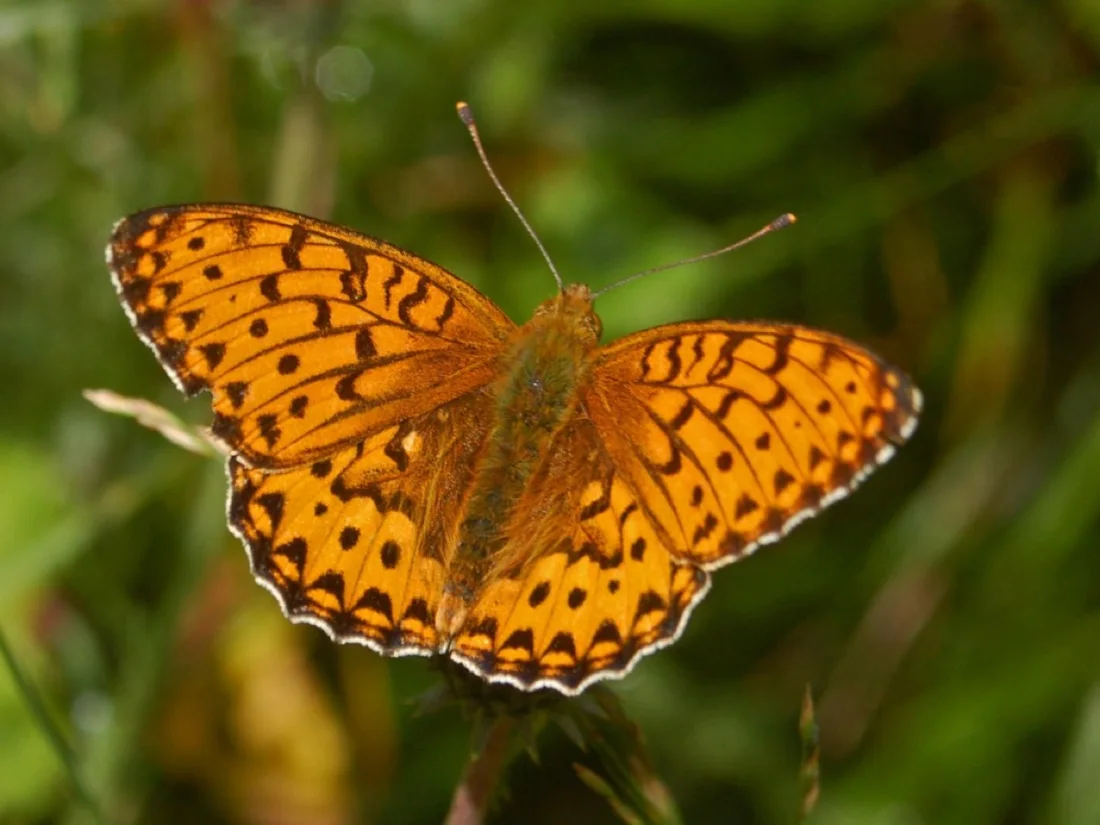
Wingspan 45–58 mm. A large fritillary, slightly above average in size for a Norwegian butterfly. The wing uppersides are light brown with numerous black markings; the forewing undersides are somewhat similar. The hindwing undersides are distinctive, with a greenish tinge and oval pearly spots, and no reddish-brown colour. According to the species handbook, the hindwing underside is mainly green, with a broad yellow band in the outer half and rows of silver spots along the outer margin and in the inner part of the wing. In the male, the first three forewing veins counted from the rear are slightly thickened with scent scales.
Similar species
High brown fritillary and Niobe fritillary are similar, but these have a range of brown eye spots within the outer row of silver spots. Due to their characteristic hindwing undersides, confusion with High brown fritillary or smaller fritillary species is considered unnecessary, according to the publication.
Distribution
Europe, North Africa, and eastward to Japan and China. Commonly found near Lofoten and further scattered in Finnmark; the northernmost findings can, to some extent, be the result of migration. In the mountains of Southern Norway, it can reach up to 1200 m. Commonly found along the edges of hills and in other open areas throughout the country, from north to south in Nordland; scattered occurrences have also been found further north. Almost all findings from Finnmark, and many from Troms, are of more recent date, which may indicate an expansion northward in line with a warmer climate. Approximately 5200 findings distributed across all of Norway’s counties.
Biology
The larvae live on violets (Viola), and overwinter as a young larva. It is black with two narrow white lines down its back, and with black, branched thorns. At each breathing hole, it has a rust-red spot. It grows up to 42 mm long. It pupates low on a decaying branch or similar. Host plants are various species of violets; it overwinters as a very young larva. When searching for nectar, it frequently seeks out red campion, red clover, thistles, and wild thyme.