
Identifying features
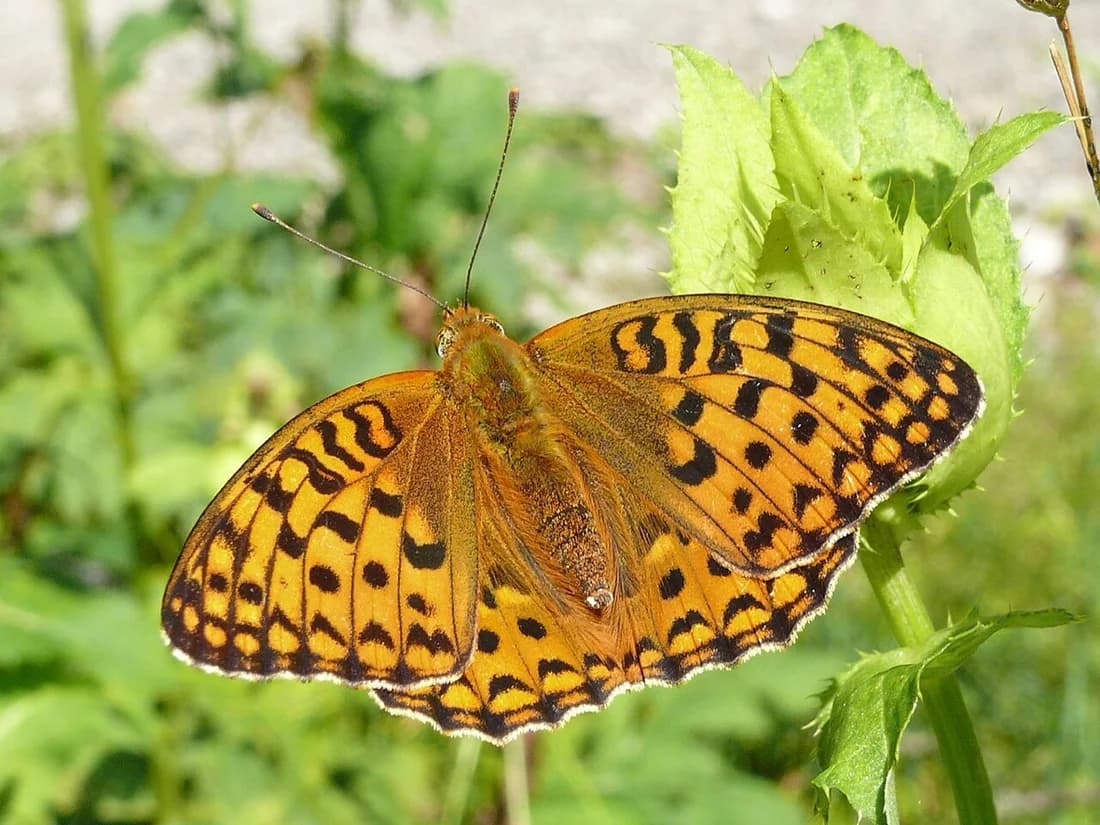
Wingspan (47) 51–63 mm. One of Norway’s four largest fritillaries. The upperside of the wings is orange with black spots and fine black veins. In the male, the veins on the forewing, veins 2+3 from the hind edge, are strongly thickened and have a dark grey core of scales. The underside of the hindwing is yellow with green and brown shading and features several large silver spots, which are occasionally yellow. Along the edge, there is a row of reddish-brown eyespots, a characteristic that distinguishes this species from Dark green fritillary.
Similar species
The species is very similar to Niobe fritillary, and the only reliable distinguishing feature is the male’s scent scales, which, like in High brown fritillary, are clearly thickened. Otherwise, the species can be distinguished from Niobe fritillary based on the following characteristics: wingspan, averaging 47–63 mm; the outer edge of the forewing is straight or slightly concave; the underside of the hindwing is usually silver, occasionally with yellow spots, often edged with black streaks, but these streaks are rarely sharply defined; the central spot of the brown-edged eye spots is usually absent. It resembles Dark green fritillary, but lacks the row of rust-coloured eye spots within the outer row of silver spots.
Distribution
Europe, North Africa, and eastward to Northern India, Japan, and China. Common on Eastern Norway, Southern Norway, and the southernmost part of Western Norway. Some finds outside this area are likely due to individuals traveling.
Biology
The larva feeds on violets (Viola) and overwinters while young. When fully grown, it is dark brown with long, branched yellow-brown spines. It has T-shaped whitish-yellow dorsal spots and small pale dots in transverse rows. The pupa hangs low in the vegetation from a dry stem.