
Identifying features
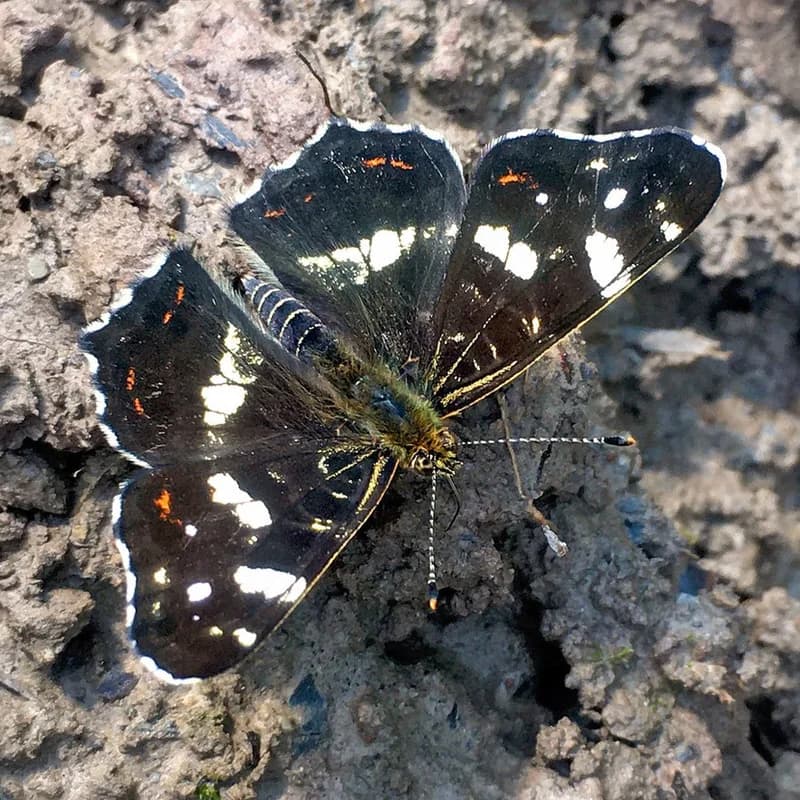
Wingspan 31–43 mm. There is a significant difference between the spring and summer generations. In the spring generation, the upper side is orange with numerous, partially merging dark brown spots. At the tip of the forewing, there are several small, white spots. In the summer generation, the upper side is black with a white band across the hindwing, and with several larger and smaller white spots on the forewing. Usually, there are also some faint, orange markings.
Similar species
The spring generation may resemble a fritillary, but has a distinctly extended forewing tip and a lobed hindwing margin with a particularly prominent lobe in the middle. The summer generation most closely resembles white admiral, but is considerably smaller, with a more lobed wing margin and more irregular wing markings.
Distribution
Between Europe, the southern part of Northern Europe, the Caucasus, extending eastward to Korea and Japan. The species has, in recent years, established itself in Southern Sweden and Southern Finland, and is slowly spreading northward. Detected once in Norway: in Tana in Finnmark in 2017. The species is expected to appear in Southern Norway as a result of expansion in Southern Sweden.
Biology
The larvae live on nettle (Urtica). It is black-brown with lighter markings, small white spots, and light brown thorns. On its head, it has two prominent horns. The first brood of larvae hatches in the same year and gives rise to the dark summer form. The second brood overwinters as pupae and hatches the following spring.