
Identifying features
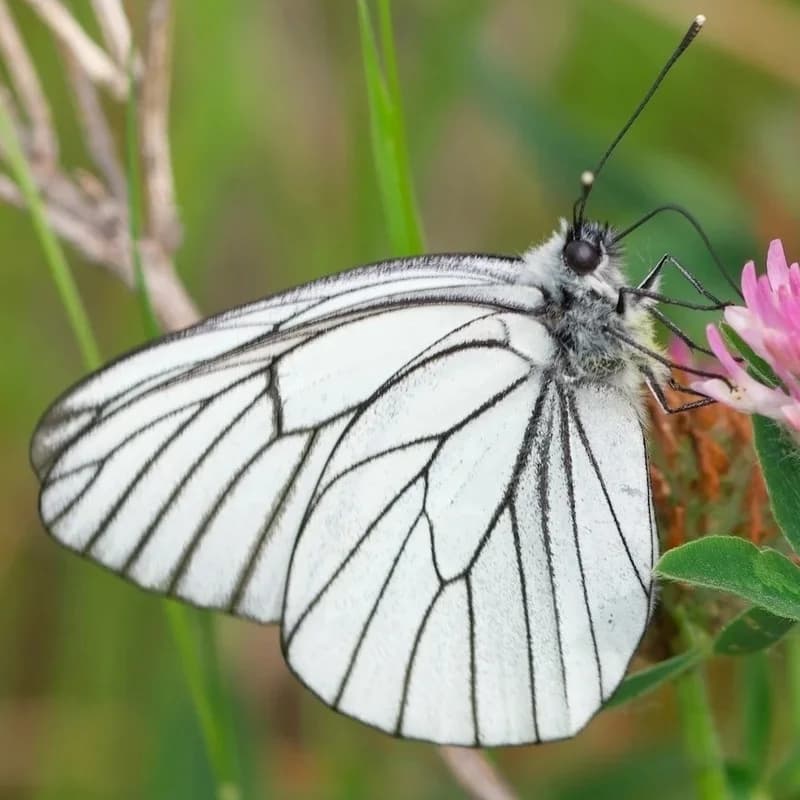
Wingspan 58–77 mm. The wings are white with distinct dark veins. The female is, on average, larger than the male and somewhat rounder in shape. A gliding fly.
Similar species
The species can resemble a Parnassius species, especially Clouded apollo, but it lacks the characteristic black markings along the edge of its forewing.
Distribution
Formerly common in Østlandet and Sørlandet. During the 20th century it disappeared from most sites, but scattered populations remain in Østfold, southern Hedmark, southern Buskerud and outer Telemark, with strong populations in inner Sogn. There was one record in Alta in Finnmark in 2004 during an influx from the east. Around 230 records, according to the 2025 booklet.
Biology
The eggs are laid on various trees and shrubs in the rose family, primarily on hawthorn or rowan (it is assumed that rowan is used most often – Norway). The larvae live together in a protective cocoon; they are fluffy and brownish-grey, with two dark red stripes along their backs, approximately 35 mm long. The larva overwinters as a small larva and pupates in late May or later. A female lays many eggs, distributed in a few clusters.