
Identifying features
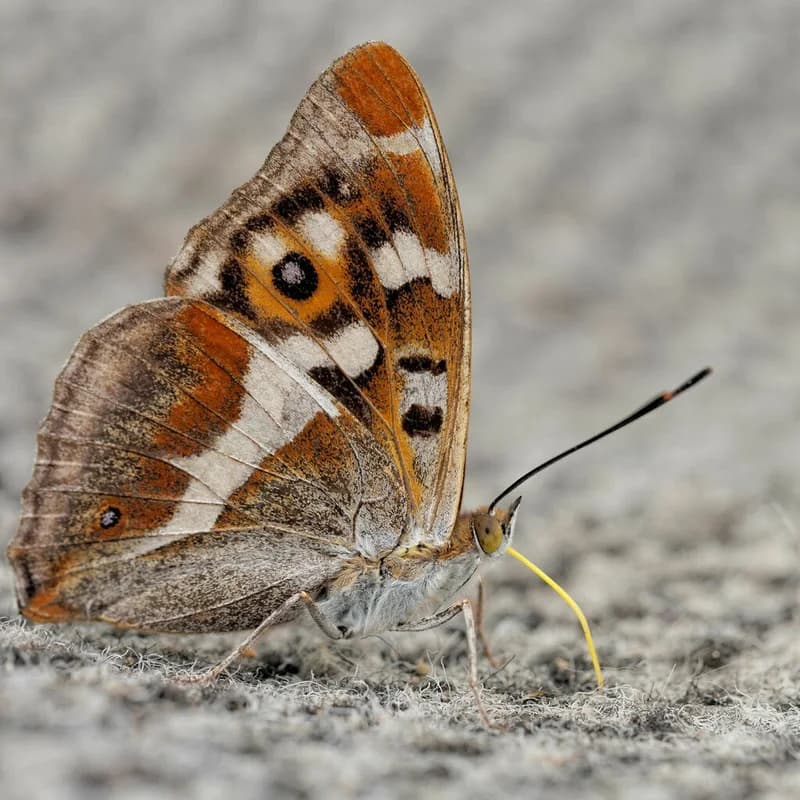
Wingspan 65–74 mm. The upper side of the wing has a dark brown base colour, and the male has a strong blue-violet sheen that is only visible in certain angles. The forewing has white spots, and the hindwing has a white transverse band in the middle of the wing. In the rear part of the hindwing, there is a round, black spot framed with orange. The underside markings consist of hazel and grey patches with the same white spots as on the upper side. On the outer part of the forewing, there is a large orange area with a prominent black eye spot with a blue center.
Similar species
The female can resemble Poplar Admiral and white admiral, but the species is characterised by the small eye spot on the upper side of the hindwing, and by the larger eye spot on the underside of the forewing.
Distribution
From Europe to the Ural, as well as in Transbaikal, Amur, eastern China and Korea. Found in Denmark, South-Sweden and South-Finland. In Norway, the species was first found in 2019, when it was observed in both Eastfold and Hedmark. The species is likely to establish itself in Eastern Norway.
Biology
The larva feeds on goat willow, eared willow and grey willow. It is green with light green diagonal stripes and two long, forward-pointing horns on its head that give it a slug-like appearance. It overwinters as a half-grown larva. The pupa hangs from the upper surface of a leaf on the host tree.