
Identifying features
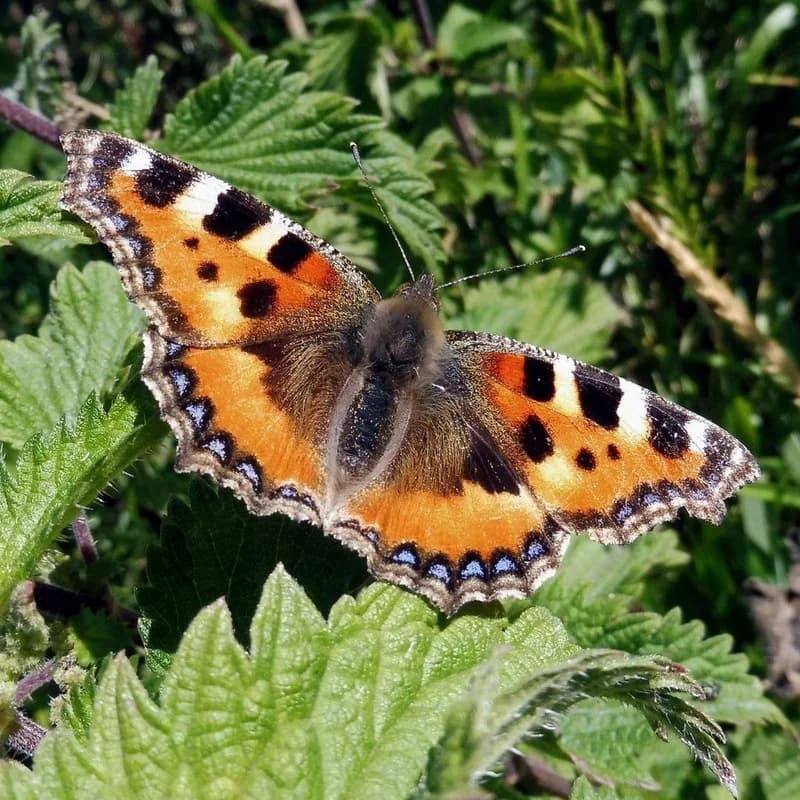
Wingspan 40–52 mm. The upper side of the wing is warm orange with a brown outer edge. Within the outer edge is a black band with blue spots. Along the leading edge of the forewing, there are alternating black and yellow spots with a white spot furthest against the edge band. In the middle of the forewing, there are two round black spots, and near the trailing edge, one large black spot with a yellow spot outside. The hindwing’s base is dark brown with golden hairs and dusting, and is clearly defined from the orange outer band. The wings’ yellow markings fade to almost white after overwintering.
Similar species
The wing patterns resemble large tortoiseshell and Yellow-legged tortoiseshell, but these are larger and less contrasting, and have two black spots along the hind edge of the forewing.
Distribution
Europe, Turkey, Central Asia, and as far as east to Japan. Common throughout the country, also in the mountains.
Biology
The larvae live in groups on nettles (Urtica). The larva is black with a dotted double yellow line along its back and yellow lines along its sides. Its spiracles are black with whitish rings. It has green legs and black spines on its back and sides and reaches a length of 35–40 mm. It pupates while hanging from the host plant or another nearby vertical surface.