
Identifying features
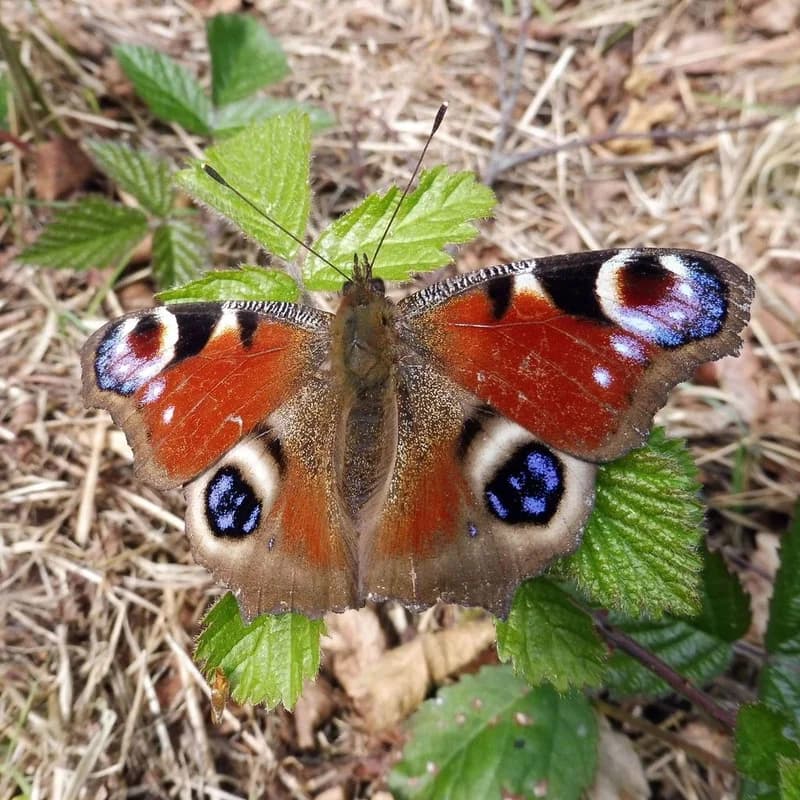
Wingspan 55–65 mm. The wing upperside has a rich reddish-brown ground colour. Both forewings and hindwings have a grey-brown margin and a large black, yellow and blue eyespot in the front section. The yellow markings fade to almost white after overwintering. The underside is dark brown with fine black lines and resembles bark.
Similar species
According to the species handbook, this species cannot be confused with other species.
Distribution
Europe and eastward to Japan. In Norway, the first findings were made in Risør in 1902. The species is now established in Southern Norway and Eastern Norway, and during warm summers, it also establishes itself outside this area. There are occasional findings as far north as Finnmark, and since approximately the year 2000, the frequency of findings in Central and northern Norway has increased. The frequency fluctuates considerably from year to year, but the species is normally very common within its range.
Biology
The larvae live in an unusual way on nettle (Urtica). They are black with small white spots and black thorns, with brown feet. They grow to 50 mm in length and pupate by hanging on a nourishing plant or on another upright object nearby. The pupae hatch after approximately 2 weeks.