
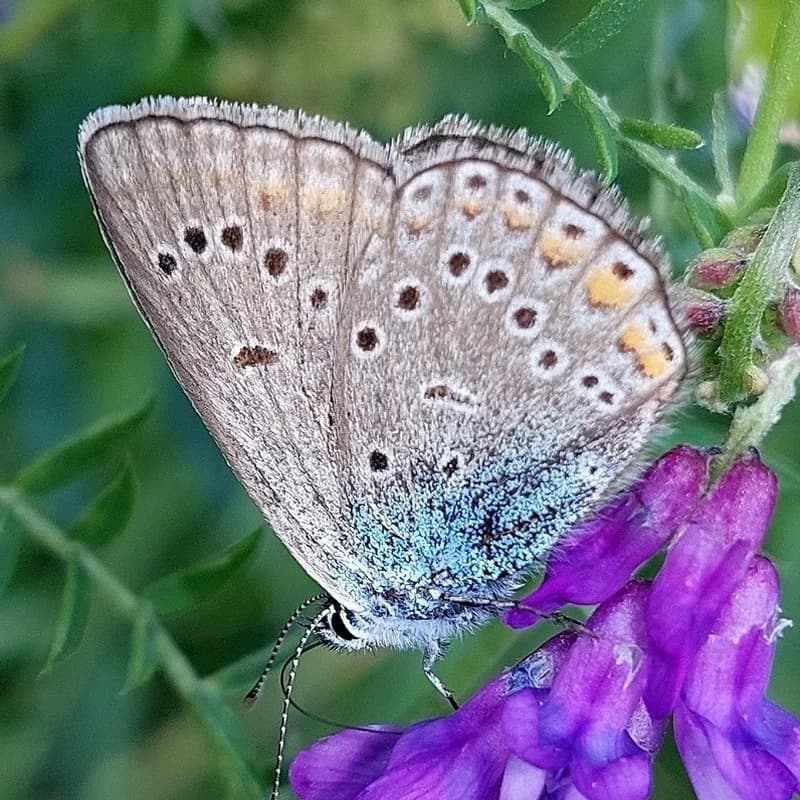
Identifying features
Wingspan: 29-35 mm. The male's upperside is clear ice-blue with a sharp, dark, shadowy stripe and long black veins that reach approximately.
Similar species
Amanda’s blue may resemble common blue, but this species lacks the long, dark veins on the upperside of the males. For females, common blue always exhibits a slight bluish tint, and never the same chocolate-brown base colour as Amanda’s blue. On the underside, it has a white wedge shape, which is located between the spots on the hindwings.
Distribution
Previously widespread and very common throughout Zealand, Funen, and Jutland, and less common on Lolland, Falster, and Møn. Amanda’s blue has been found less than 10 times on Bornholm, likely with all sightings being of migrant specimens.
Biology
In Denmark, it lives on mouse-ear hawkweed. In the rest of Europe, however, it can also breed on other hawkweed species.