
Identifying features
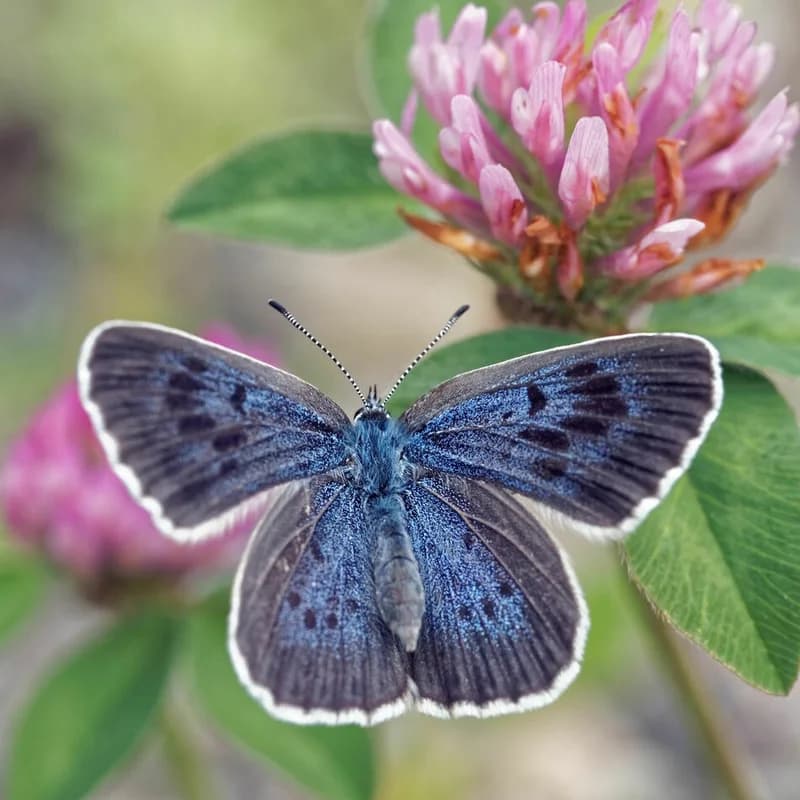
Wingspan: 32-45 mm. Both sexes have a greyish-blue upperside with characteristic black spots on the forewing.
Similar species
It can be confused with females of Alcon blue, and specimens without spots may potentially be classified with Amanda’s blue, but usually, the size alone, together with the large black spots, is sufficient for a reliable species distinction. A certain characteristic of Denmark is that the species only occurs at one location, Høvblege on Møn, where Alcon blue is not found and Amanda’s blue is rarely seen.
Distribution
Large blue is a species that – from thriving in many Danish locations during the mid-1900s – has been very close to extinction in Denmark. The last Danish location is Høvblege on Møn, where the population is stable, but very vulnerable.
Biology
The larvae feed on thyme, mainly broad-leaved thyme but formerly also narrow-leaved thyme, as well as marjoram. After several moults, a larva drops to the ground. If all goes well, it is adopted by an ant of the species Myrmica sabuleti and carried into the nest.