
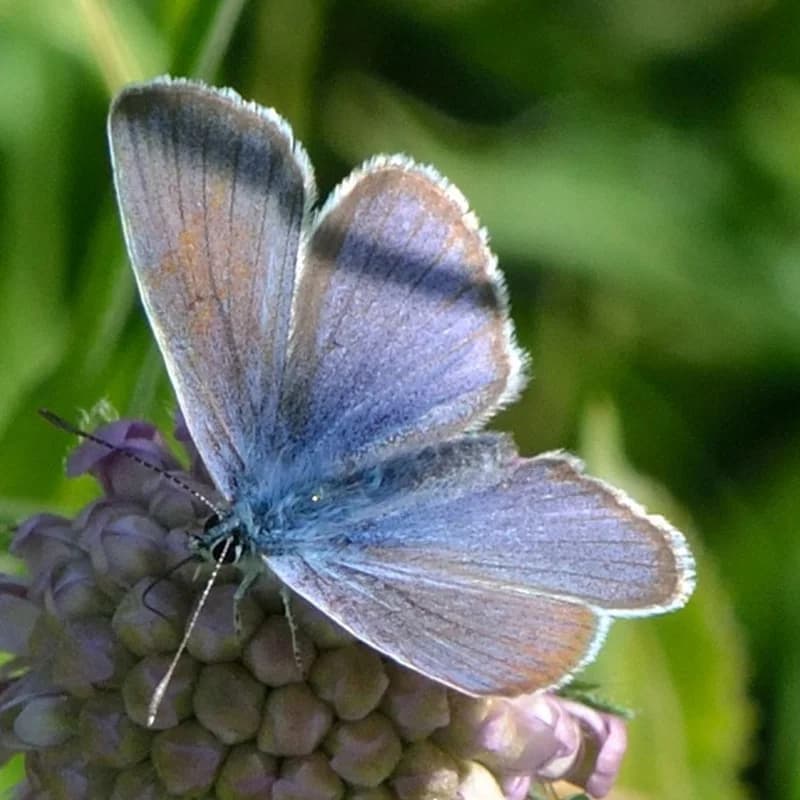
Identifying features
Wingspan: 28-38 mm. The male's upperside is shining violet-blue with a narrow, black border.
Similar species
The male can primarily be confused with worn males of Amanda’s blue. However, the orange markings on Amanda’s blue are usually sufficient for reliable differentiation.
Distribution
Alcon blue has disappeared from approximately 1/7 of its known locations over the past 40-50 years. Currently, it can be found on Rømø, Fanø, and Læsø, in some areas along the Jutland west coast, and in Thy, in the plantations near Frøslev Mose, close to the Danish-German border, and finally in Grene Sande near Billund, which is one of the last 3-4 Danish populations.
Biology
The larvae of the alcon blue feed in the seed heads of marsh gentian, possibly also other gentians. After a few moults, a larva drops to the ground, where it is adopted by one of two Myrmica ant species (Myrmica rubra and Myrmica ruginodis). It then lives in the ants’ nest and is fed by the ants in the same way as their own larvae.