
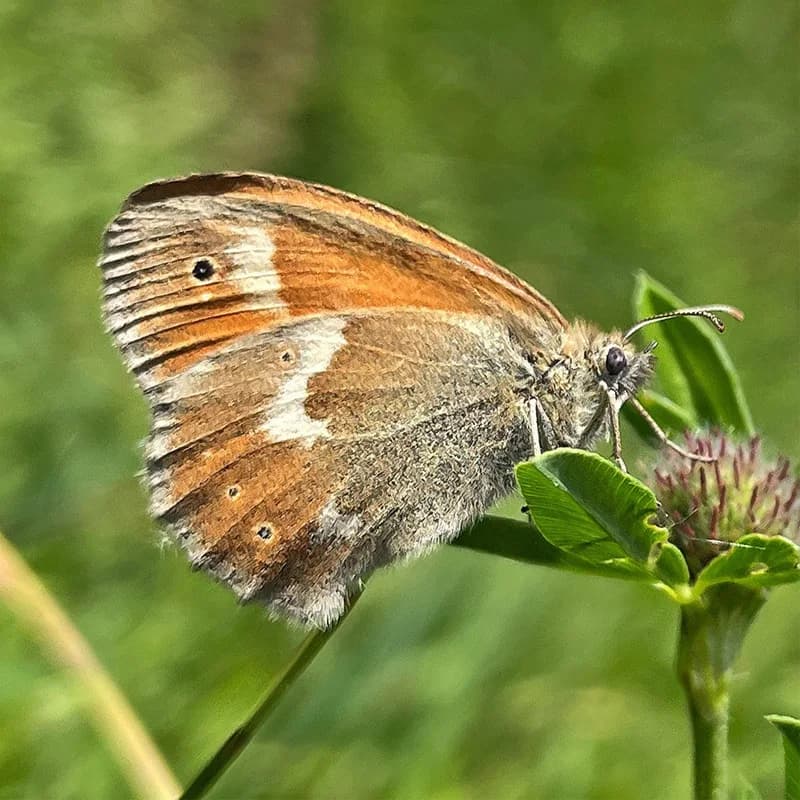
Identifying features
The upperside of the wings is ochre-orange, often with a number of small eyespots. The undersides of the forewings are also ochre-orange, with 1-2 eyespots, as well as a pale stripe that runs in front of the eyespot, and 'may' connect to the 'similarly coloured' pale stripe that runs down the undersides of the hindwings (provided the forewing is held at the correct angle).
Similar species
Can easily be confused with the somewhat smaller and paler small heath. That species usually lacks the large heath’s distinctive eyespots, but eyespots can occur, so compare several features. The small heath can have a small pale stripe on the underside of the forewing.
Distribution
Widespread throughout all parts of Jutland (including Læsø, Rømø, and Fanø), but sparse in (particularly) West and East Jutland.
Biology
In Denmark large heath is mainly associated with quaking bogs and raised bogs with cotton grass, reflected in its Danish name. At several sites, particularly in West Jutland, it also lives on nutrient-poor heathland bogs or simply in damp areas with cotton grass.