
Identifying features
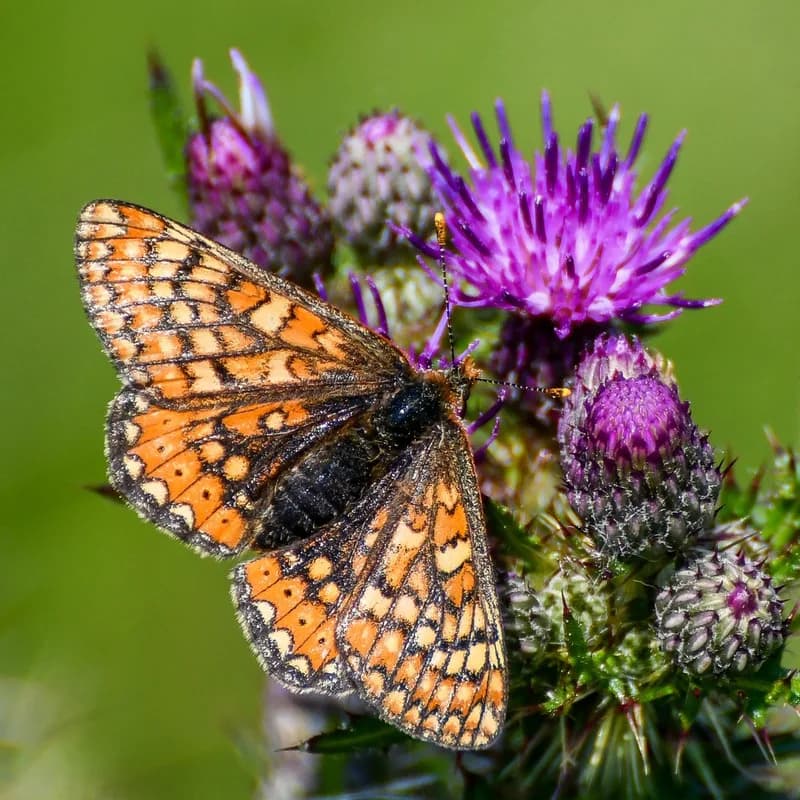
Wingspan: 30–40 mm. Newly emerged individuals are striking, with garlands of small white, red and orange patches on the wing uppersides. On the hindwings, the outer field has black spots in the second row of orange patches from the outer edge.
Similar species
Marsh fritillary can be confused with Glanville fritillary, Scarce Fritillary, heath fritillary, and false heath fritillary. Glanville fritillary has a more uniformly orange-ochre yellow wing upper side with a lot of dark markings, in contrast to marsh fritillary, which has a highly nuanced, reddish upper side.
Distribution
Marsh fritillary has previously been found in a few locations on Zealand, including the heathland of Melby Grasslands (until the 1950s) and along the woodland roads in the nearby Tisvilde Hegn (until the 1920s), but otherwise, there is only knowledge of a few populations on the islands.
Biology
Male marsh fritillaries fly rapidly in a zigzag over the vegetation in search of unmated females. During mating, the male deposits a foam-like substance on the female’s abdomen, which quickly dries.