
Identifying features
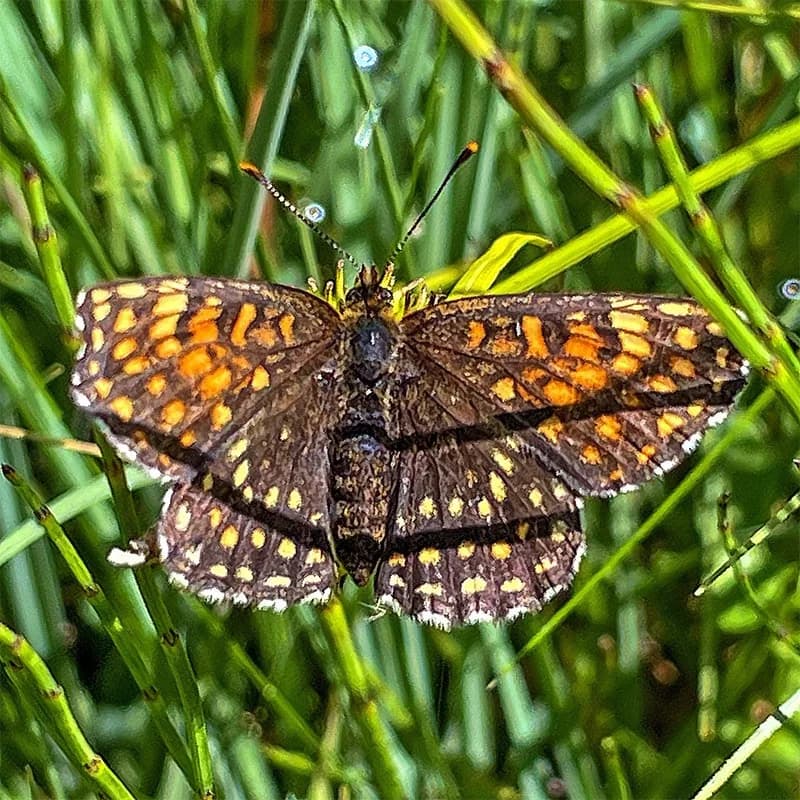
Wingspan: 35–40 mm. The wing uppersides are dark brown with small orange, fairly square spots.
Similar species
False heath fritillary can easily be confused with Glanville fritillary, heath fritillary and, to some extent, marsh fritillary. Glanville fritillary has spots in the outer field of the hindwings, in the second row of orange patches from the edge, which false heath fritillary lacks. Its wing uppersides are also lighter and more ochre-orange, whereas those of false heath fritillary are darker and more brownish.
Distribution
When the last Danish false heath fritillaries were seen in 1982 at Farum Sortemose and near Bastrup Sø, the species had already been in extreme decline for 15 years. Even in the mid-60s it could still be found at several sites in northern, central and western Zealand and at its last two sites on Funen, near Bramstrup and at Højes.
Biology
The flight of false heath fritillary is rapid, low, and hovering. When the species is not foraging for nectar, it readily basks in the sun.