
Identifying features
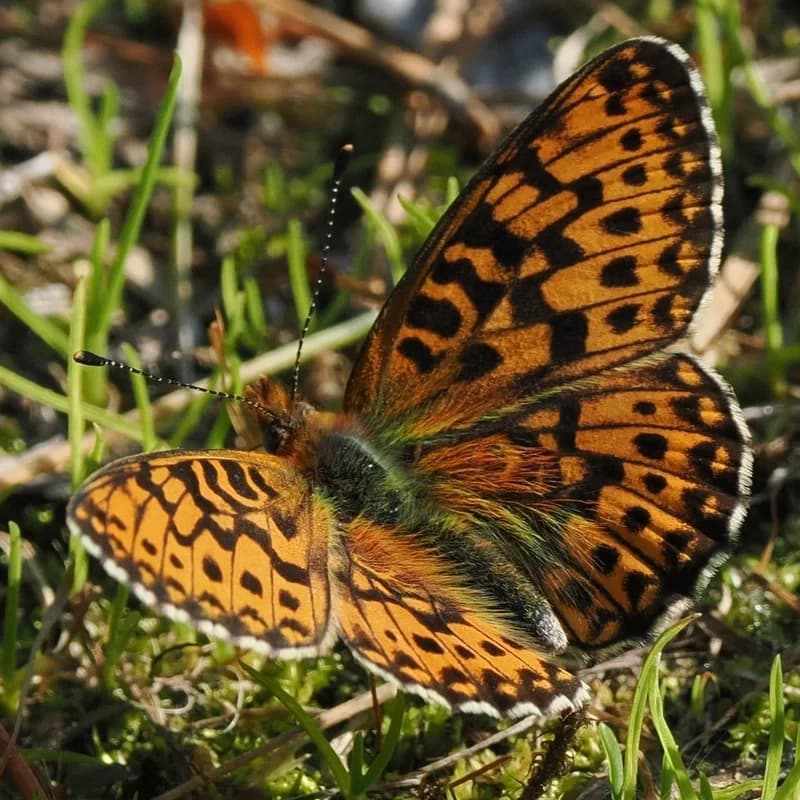
Wingspan: 34–45 mm. The wing uppersides are warm red, with black spots and separate, diffuse triangular spots along the outer margin.
Similar species
Pearl-bordered Fritillary can be confused with the other small pearl moths. Specifically, it resembles small pearl-bordered fritillary, which is recognised by the fact that Pearl-bordered Fritillary has diffuse-triangular stitch patterns that are separated, whereas small pearl-bordered fritillary has sharp, continuous, and V-shaped ones.
Distribution
Previously widespread and common throughout Danish forests, except for Bornholm, where the species has never been found. Today, Pearl-bordered Fritillary is unfortunately becoming very rare in Denmark, with only a few remaining populations in Midtsjælland, Lolland, and Falster.
Biology
The eggs are laid on sunlit violets, preferably on a south-facing slope. The violets should be planted in open, uncolonised owl grass, or among scattered, decaying leaves, as the larva depends on a warm microclimate in the following spring, basking in the sun on decaying leaves and other plant remains.