
Identifying features
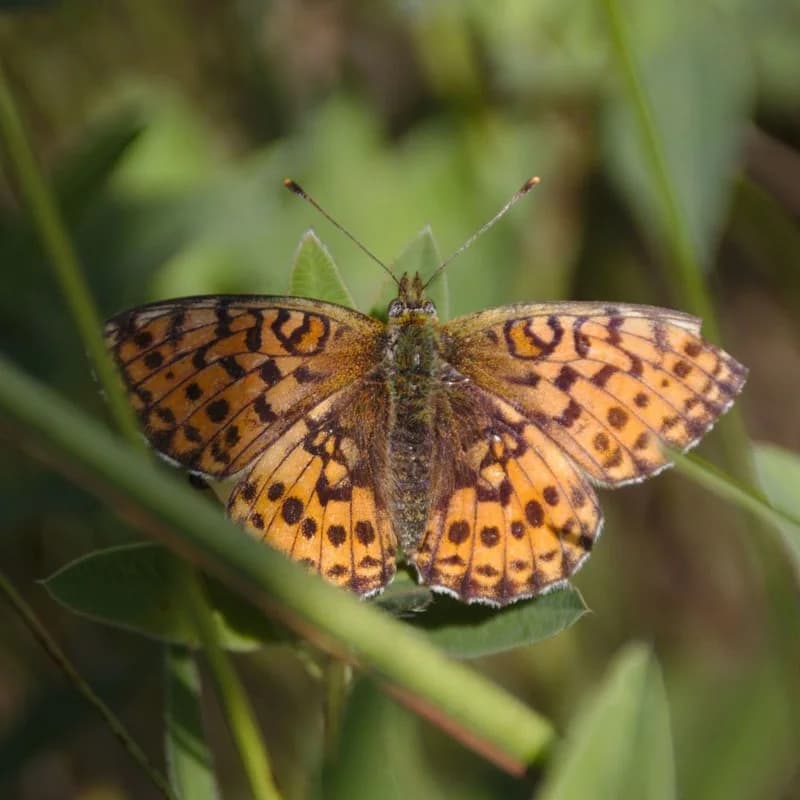
Wingspan: 33-42 mm. The upperside is reddish-brown with small spots and a distinct black border along both forewings and hindwings, while the underside features light yellowish pearly spots and a violet sheen across the central area of the hindwing underside.
Similar species
Lesser Marbled Fritillary can be confused with all the other small fritillaries, but is characterised by its unique pattern on the underside of the hindwing, where there are no black spots, the clear, broad, continuous black marginal band on the upperside, and the small, indistinct marginal spots.
Distribution
Lesser Marbled Fritillary was once a relatively common butterfly in Funen, Bornholm, most of Zealand, and with some populations on Lolland-Falster-Møn. From Jutland, the species is known from Femmøller (Mols Mountains) in 1975, Rosenvold (Vejle Fjord) from 1975-1978, and Trelde Næs (also in the vicinity).
Biology
Lesser Marbled Fritillary flies in June/July, when the moors have become warm and the larvae emerge. The eggs are laid individually on the leaves of Filago vulgaris.