Field guide · Denmark
Brush-footed butterflies · Denmark

High brown fritillary

Fabriciana adippe

The high brown fritillary is rare in Denmark. Its wingspan is 50-60 mm (male-female). It flies from late June to early September. In North Jutland it inhabits heathland and dunes, like the Niobe fritillary. On Zealand and Bornholm it lives in unfertilised woodland meadows and similar habitats, usually with plenty of suitable nectar plants.

Status in this countryRare in DenmarkNT (Near threatened)
High brown fritillary

Flight period

The flight period is from the end of June to early September. Interestingly, the forest-dwelling, Danish and Bornholm populations typically begin their flight period a little before the (usually) migratory individuals in North Jutland.

Habitat

In North Jutland high brown fritillary is associated with heathland and dunes, like Niobe fritillary. On Zealand and Bornholm it lives in unfertilised woodland meadows and similar habitats, usually with plenty of suitable nectar plants.

Identifying features

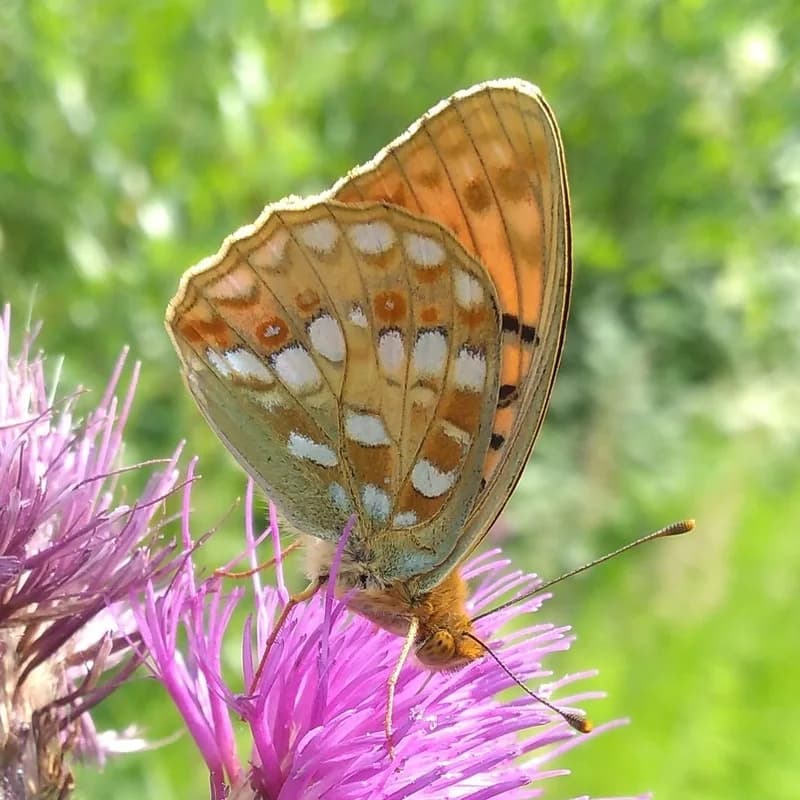
Wingspan: 50–60 mm (male–female). The uppersides of both pairs of wings are orange, with black spots and markings.

Similar species

High brown fritillary can easily be confused with Dark green fritillary and (especially) Niobe fritillary. Dark green fritillary, however, has a very distinctive greenish underside on its hindwings, whereas High brown fritillary only has a faint green-brown dusting.

Distribution

High brown fritillary is still relatively common on Central and Southern Zealand, especially on Stevns, where it can still be found in many places. High brown fritillary has completely disappeared from Funen, Lolland-Falster, and North Zealand (where it was previously very common).

Biology

Just as Dark green fritillary, High brown fritillary exhibits a hovering flight, with regular, powerful wingbeats. It is a keen flower visitor and spends a great deal of time foraging.