
Identifying features
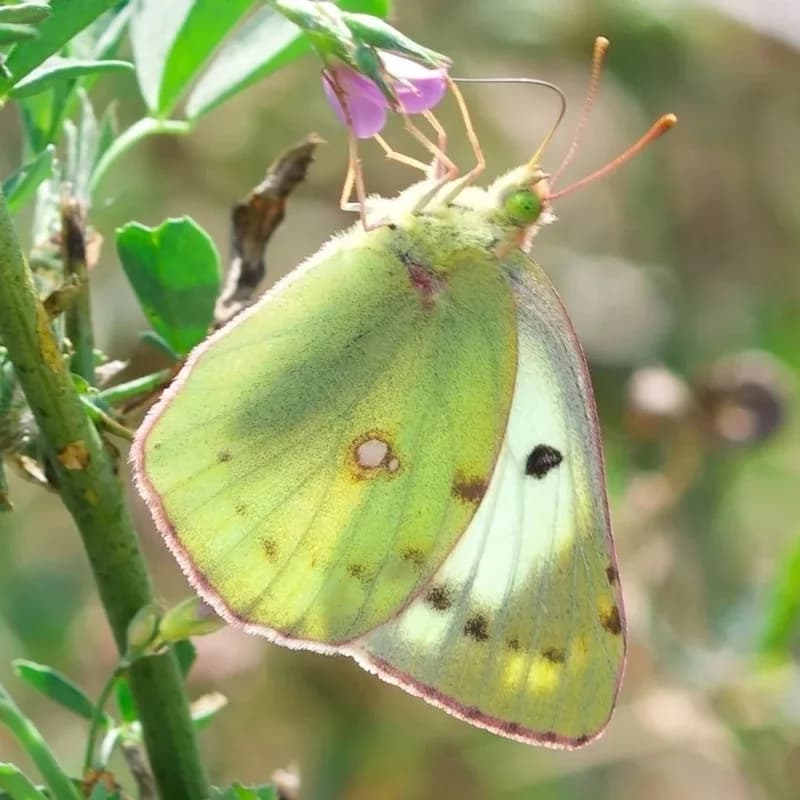
Wingspan: 43–50 mm. The male is pale yellow with a black forewing border. The hindwing border has varying amounts of black scaling and may be almost absent.
Similar species
It can particularly be confused with the southern summer butterfly. It can be distinguished from this butterfly by its wing shape, which is much rounder in the southern summer butterfly, and by the extent of the outermost yellow spots in the dark band, which are continuous in the southern summer butterfly. Pale clouded yellow is known from common clouded yellow by its colour and by the fact that the male of common clouded yellow does not have yellow spots.
Distribution
Rare, but can be observed throughout Denmark. Most individuals migrate south and east, and are therefore most frequently seen around Lolland-Falster, Vordingborg, Stevns, and Amager.
Biology
Pale clouded yellow is a strong-flying migratory species, adapted to clear areas and wastelands with pioneer plants such as lucerne and scabiosa. Pale clouded yellow has many successive generations throughout the summer, and it becomes increasingly common throughout the summer, during which it also spreads further north.