
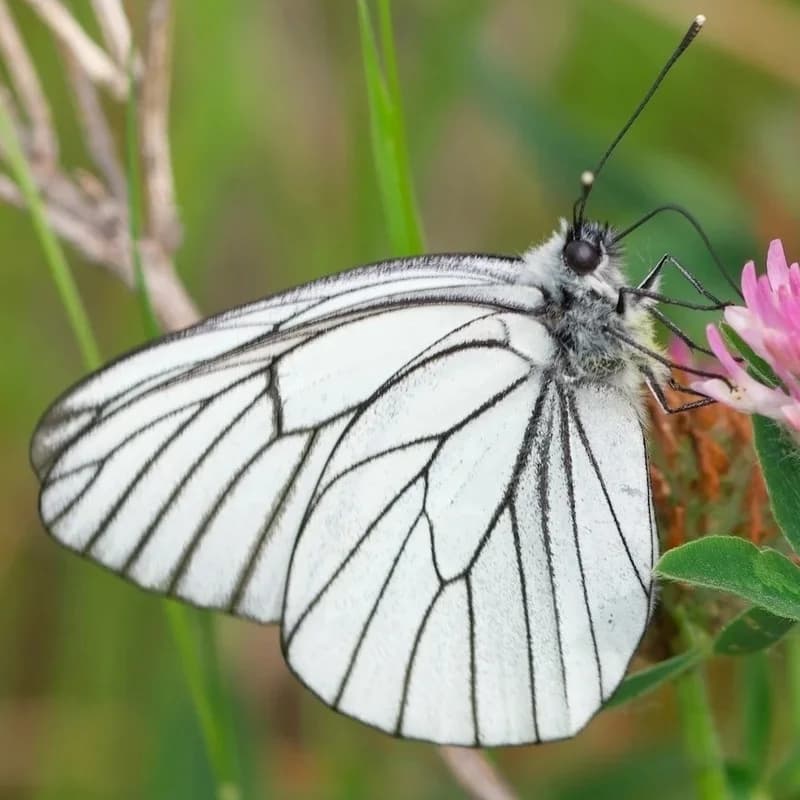
Identifying features
Wingspan is 50-65 mm. The body is entirely black, while the wings are white with very prominent dark veins.
Similar species
Black-veined White can be confused with cabbage whites, which can be identified by the absence of dark spots and patches on both the upper and lower sides of the wings, and on the prominent dark wing veins. It can also be confused with the white-winged warbler (Siona lineata), which also has a thin, dark border, but this is located further in on the wing, where Black-veined White is located closest.
Distribution
Black-veined White appears in several suitable locations throughout Jutland, but is absent in large parts of Southern Jutland, West Jutland, and North Jutland. After having been very rare for several decades, it has become reasonably common throughout Jutland.
Biology
The flight of Black-veined White is rapid and floating. In certain locations, mass appearances can occur in a single year, where the adult butterflies can be observed in the hundreds.