
Identifying features
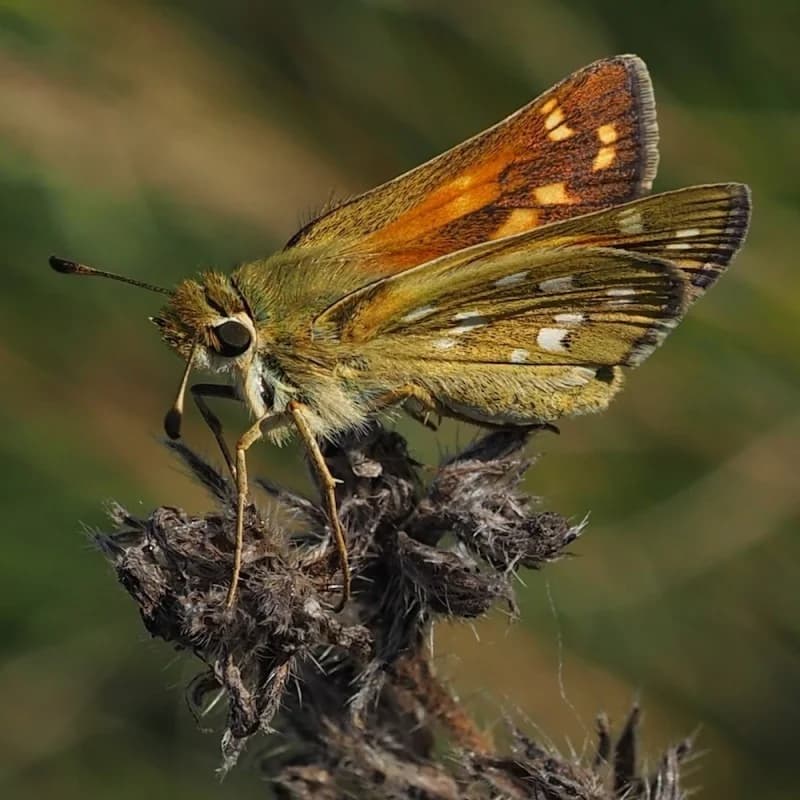
Wingspan: 24-32 mm. The ground colour is ochre yellow to brown.
Similar species
Silver-spotted skipper can be easily confused with Large skipper, but is distinguished from it by the large and prominent white spots on the undersides of the wings. Furthermore, the males of silver-spotted skipper (unlike the males of Large skipper) have a narrow, elongated, and white scent scale patch in the center of the black comma-shaped spot on the upperside of the forewing.
Distribution
Silver-spotted skipper was formerly widespread on the Danish islands, with populations on Lolland, Falster, Møn, Funen, Bornholm and most of Zealand. However, it began disappearing rapidly from its eastern Danish sites as early as the beginning of the 20th century.
Biology
Silver-spotted skipper readily visits many kinds of flowers, including thistles and bird’s-foot trefoil. Field scabious is also particularly popular.